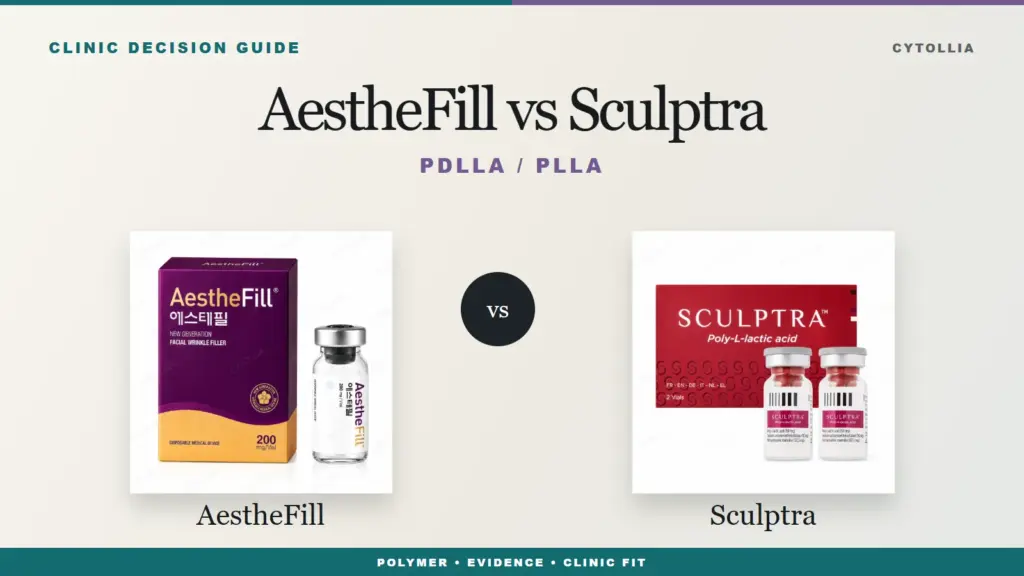
AestheFill and Sculptra belong to the same broad polylactic-acid biostimulator family, but they are not the same product in two boxes. AestheFill uses poly-D,L-lactic acid, or PDLLA. Sculptra uses poly-L-lactic acid, or PLLA. Their formulations, particle characteristics, labels and evidence packages differ—and those differences matter before a clinic treats either product as a menu substitute.
This guide compares what can be documented now, separates laboratory observations from clinical conclusions, and shows which questions still require the exact local instructions for use, professional training and supply documentation.
Quick answer
PDLLA versus PLLA is the start of the decision—not the verdict
AestheFill is a PDLLA-and-CMC lyophilized product; Cytollia currently lists a 200 mg presentation. Sculptra is a PLLA product with CMC and mannitol; its current U.S. instructions describe a 367.5 mg dose vial, while Cytollia currently lists a two-vial carton. Both require product-specific preparation before professional use.
No reliable source reviewed for this article establishes one universal winner. A clinic should compare the supplied product, local label, preparation workflow, evidence strength, patient communication needs and permitted supply route—not turn the polymer abbreviation into a safety or efficacy ranking.
This is professional product education, not an injection protocol or individual treatment recommendation. Exact indications, preparation, contraindications and use must follow the current product information approved in the relevant market.
Product DNA
What is actually inside each product platform?
AestheFill
PDLLA + CMC
An amorphous polylactic-acid platform
REGEN Biotech identifies AestheFill as an injectable poly-D,L-lactic acid product. Peer-reviewed descriptions of the 200 mg presentation report 154 mg of PDLLA particles with 46 mg of carboxymethylcellulose, or CMC, supplied as a lyophilized product for reconstitution.
PDLLA contains both D- and L-lactic-acid units in a randomly arranged polymer chain. That makes the polymer amorphous rather than the more ordered semicrystalline structure associated with PLLA. It does not, by itself, prove that every PDLLA product will produce the same handling, tissue response or clinical result.
CMC is part of the supplied formulation, not a reason to describe AestheFill as an HA gel. Product behaviour can also reflect particle manufacturing, surface characteristics and how the excipient is integrated with the polymer. A clinic is therefore evaluating the complete AestheFill presentation—not purchasing a generic result called “PDLLA.”
Sculptra
PLLA + CMC + mannitol
A semicrystalline PLLA platform with a U.S. device label
Galderma’s U.S. instructions describe Sculptra as an injectable implant containing PLLA microparticles, sodium carboxymethylcellulose and mannitol. It is supplied in sterile lyophilized vials and must be reconstituted to form a suspension before use.
PLLA contains the L-lactic-acid stereoisomer in a more ordered polymer structure. Sculptra’s U.S. label describes gradual correction over several weeks, which is why temporary fullness from reconstitution fluid should not be presented as the completed result.
Mannitol and CMC are part of the Sculptra formulation described in the U.S. label. Their presence reinforces the same practical point: a PLLA product cannot be reduced to its base polymer. The exact formulation, supplied vial, approved instructions and manufacturing controls travel together as one product identity.
AestheFill vs Sculptra at a glance
The documented differences—and the question each one creates
| Field | AestheFill | Sculptra | Clinic question |
|---|---|---|---|
| Polymer | PDLLA: poly-D,L-lactic acid | PLLA: poly-L-lactic acid | Is the team evaluating the exact product, or assuming that all PLA formulations behave alike? |
| Other reported components | CMC in the peer-reviewed 200 mg product description | CMC and mannitol in the U.S. IFU | Does the supplied local label match the formulation used in the comparison? |
| Current Cytollia listing | 200 mg lyophilized powder; product ID 735 | Two-vial carton; product ID 775 | Are pack price, inventory unit and service economics being compared as equivalent when they are not? |
| Preparation | Both are supplied as lyophilized products and require product-specific reconstitution. | Does the clinic have the current IFU and training for the exact supplied product? | |
| Open product-level evidence | A 2025 peer-reviewed laboratory study tested both products directly, but did not compare clinical efficacy or safety. | Is a laboratory difference being overstated as a patient outcome? | |
| Regulatory wording | Country-specific availability and intended use; do not describe as U.S. FDA-approved from the sources reviewed here | U.S. IFU and indications are publicly available | Can every visible claim be tied to the supplied product and target market? |
| Universal winner? | Not established. Polymer, packaging and laboratory findings do not create a general clinical ranking. | What specific, evidence-supported role would the product fill in this clinic? | |
Study reality check
What the direct product study shows—and what it cannot prove
A 2025 laboratory study compared AestheFill, Sculptra, NeoFilera and Juvelook. It assessed functional groups, particle morphology and size, reconstitution under a standardized test condition, osmotic pressure and viscosity. The authors reported predominantly spherical, rough-surfaced AestheFill particles averaging about 25 μm and sheet-like Sculptra particles averaging about 50 μm.
The study also found that products sharing a polymer family did not necessarily share the same surface morphology or handling profile. AestheFill and NeoFilera were both described as PDLLA-and-CMC products, yet their particle surfaces differed. That makes the product-level evidence more useful than a simple “PDLLA versus PLLA” label.
Under the study’s standardized powder-to-water condition, Sculptra dispersed faster than AestheFill. That observation is useful—but it is not a replacement preparation instruction. The researchers did not use every manufacturer’s original powder-to-water ratio, judged complete dispersion visually, and stated that these limitations could affect the result.
Do not turn this study into a product ranking
- It was a physicochemical laboratory comparison, not a randomized head-to-head clinical trial.
- Particle shape or size cannot be converted directly into “safer,” “stronger” or “more natural.”
- The experiment does not establish a lower nodule rate, better longevity or a preferred injection area.
- Preparation in practice must follow the current local IFU and product-specific training.
The study declared no conflicts of interest and reported funding from Taiwan’s National Science and Technology Council. Its product measurements are useful for product education; its clinical implications still require direct clinical research.
Treatment journey
The shared timeline is gradual—but the products need separate scripts
This timeline is for expectation management, not treatment instruction.
Results and longevity
Which works faster—and which lasts longer?
REGEN describes an initial filling phase for AestheFill. Sculptra’s U.S. IFU explains that early post-treatment fullness can reflect reconstitution fluid and swelling. These are not equivalent measures of a final result.
Both product narratives involve collagen-associated change over time. The timing and clinical plan must come from the exact product evidence and local label, not from PDLLA or PLLA alone.
Not established. U.S. Sculptra materials report improvement lasting up to two years in a specified study. The open AestheFill manufacturer page does not provide an equivalent directly comparable duration dataset.
A maximum duration number is not a guarantee. Until comparable product-level clinical evidence uses the same indication, outcome measure and follow-up, the responsible answer is to avoid declaring either product longer-lasting.
Clinic fit
Which product role is the clinic actually trying to fill?
Evaluate AestheFill when
The clinic has a defined PDLLA question
- The target market’s approved product information is available.
- The team has product-specific professional training.
- The supply route and traceability documents can be verified.
Evaluate Sculptra when
Label familiarity supports a distinct role
- The local Sculptra version and indications are confirmed.
- The team can support its preparation and gradual-result communication.
- Demand is based on a defined product role, not brand recognition alone.
Carry both only when
The difference survives an evidence check
- The clinic can explain two non-duplicative roles without inventing superiority.
- Records preserve the exact brand, pack, lot and expiry.
- Turnover supports two SKUs rather than duplicating slow stock.
Do not assign one product to a forehead, tear trough, temple or another named area from a generic online chart. Anatomical use depends on the exact local indication, the professional assessment, training and the supplied product—not a broad polymer category.
Stocking strategy
Compare the documentation and unit—not only the box price
Consultation language
Explain the difference without selling a winner
“AestheFill is a PDLLA product and Sculptra is a PLLA product, but the polymer name does not decide the result by itself.”
“We use the exact product label, evidence and assessment rather than promising that one material is universally safer, faster or longer-lasting.”
Safety and regulatory boundaries
A material comparison is not a safety ranking
Product-specific information still controls
Sculptra’s U.S. IFU includes contraindications, warnings and reports of delayed papules or nodules. REGEN’s public AestheFill page directs professionals to the applicable IFU for adverse-reaction information. The absence of an equally detailed open page is not evidence of lower risk.
Procedure risks remain important
The U.S. FDA warns that unintended intravascular injection of dermal filler can cause tissue necrosis, vision abnormalities including blindness, or stroke. Only appropriately licensed and trained healthcare professionals should perform these procedures.
This guide does not provide doses, dilution volumes, injection planes, devices, techniques or a complication-management protocol. It also does not support an HA-equivalent hyaluronidase reversal promise for these non-HA polymer particles.
Frequently asked questions
What clinics search about AestheFill vs Sculptra
Is AestheFill the same as Sculptra?
No. AestheFill uses PDLLA with CMC, while Sculptra uses PLLA with CMC and mannitol in the U.S. product description. Both are lyophilized PLA-family products, but their formulations, labels and product evidence differ.
What is the difference between PDLLA and PLLA?
PDLLA contains both D- and L-lactic-acid units in a randomly arranged, amorphous polymer. PLLA uses the L form in a more ordered, semicrystalline structure. Those material facts may contribute to product differences, but they do not predict a universal clinical winner.
Which is better, AestheFill or Sculptra?
Neither is established as universally better. Compare the exact local label, product evidence, preparation workflow, clinic role, supply documentation and professional assessment.
Does AestheFill reconstitute faster than Sculptra?
Do not make that blanket claim. A 2025 laboratory study using one standardized test condition observed faster Sculptra dispersion, while a separate manufacturer-linked publication discusses different processes. Neither source replaces the current product-specific IFU.
Which product works faster?
The sources do not provide an equivalent head-to-head clinical measure of result speed. Early fullness and a final collagen-associated result are different outcomes, so they should not be ranked as if they were the same endpoint.
Which lasts longer?
A universal longevity winner is not established. U.S. Sculptra materials report improvement lasting up to two years in a specified study, while the open AestheFill manufacturer page does not provide an equivalent directly comparable duration dataset.
Are both products FDA-approved in the United States?
No source reviewed for this guide supports describing both that way. Sculptra has a publicly available U.S. device label. The reviewed AestheFill source says availability and intended use vary by country; it should not be presented as U.S. FDA-approved without a current FDA product record.
Can a clinic treat AestheFill and Sculptra as interchangeable?
No. Even when two products share a broad PLA-family purpose, their formulation, label, preparation, pack, evidence and supply requirements remain product-specific.
Current Cytollia catalogue
Review the exact listing and documentation
Cytollia currently lists both products. Check the current pack, availability and documentation before making a procurement decision; no price is copied into this guide.
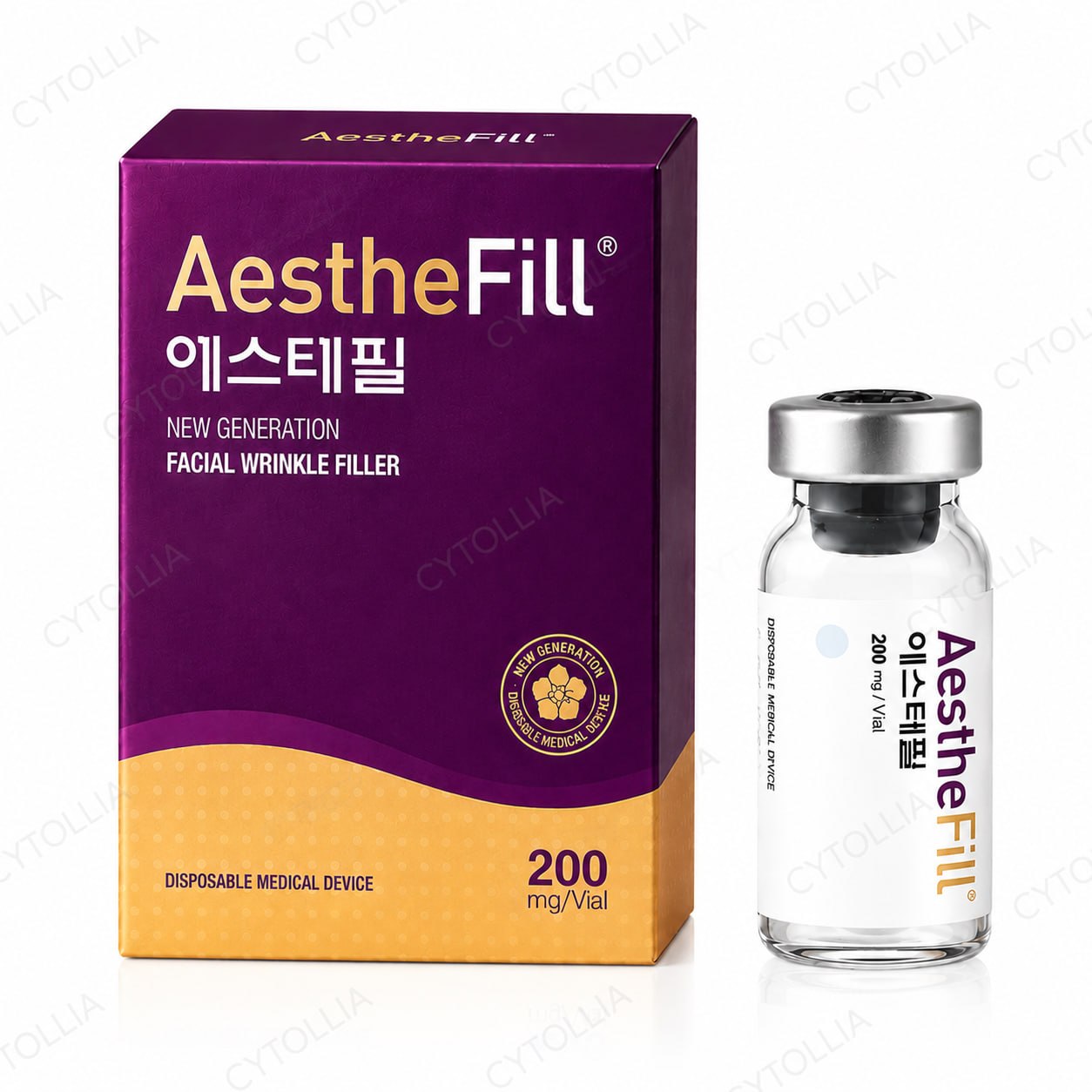 PDLLA / CMC product platformAestheFill · 200 mgReview current product listing →
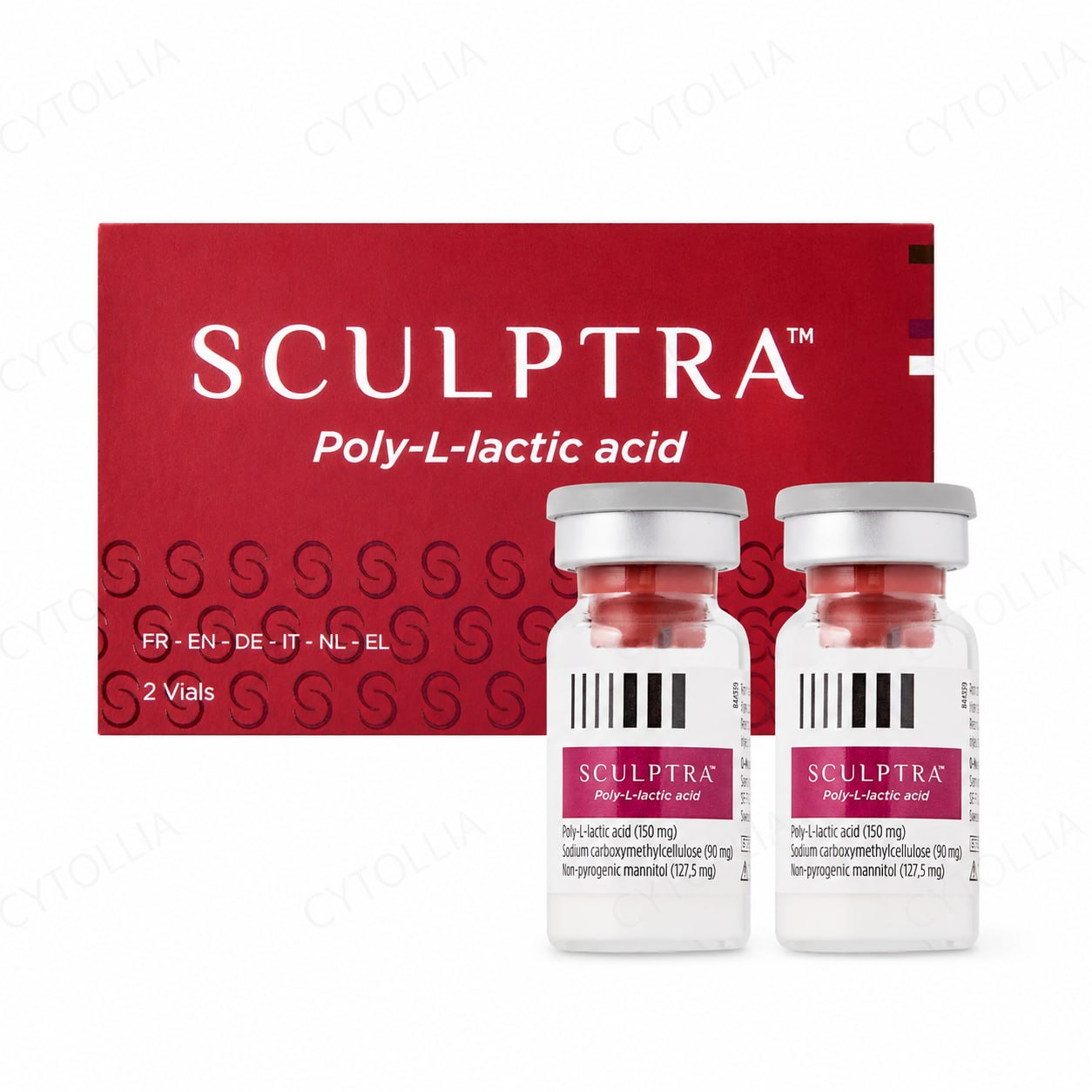 PLLA / CMC / mannitol platformSculptra · 2 vialsReview current product listing →
Browse the biostimulatory filler catalogue · Read the Radiesse vs Sculptra clinic guide · Compare Juvelook and Juvelook Volume
Sourcing note: REGEN’s public page says AestheFill availability and intended use vary by country, directs enquiries to local distributors or partners, and warns against online purchase of dermal fillers. Before publication with a commercial CTA, Cytollia should confirm that the supply route and documents are permitted for the target market. A public listing alone does not establish authorization.
Sources and editorial notes
- REGEN Biotech — official AestheFill product page, country and professional-use notices
- Galderma — Sculptra U.S. electronic Instructions for Use
- Galderma — U.S. Sculptra label update and result context
- Su et al. — direct physicochemical comparison of AestheFill, Sculptra, NeoFilera and Juvelook
- Lin et al. — comparison of Sculptra and AestheFill reconstitution processes
- Consensus recommendations — PDLLA/AestheFill composition and product context
- U.S. FDA — dermal filler indications, professional-use advice and procedure risks
Last verified: August 12, 2026. Current Cytollia product identity, public listing status and links were checked against the WooCommerce Store API. Publication must recheck availability, pack details, local product information and all source URLs.
Evidence context: the 2025 physicochemical study declared no conflicts and reported public research funding. The reconstitution comparison is a short publication whose conflict statement identifies two authors as REGEN Biotech medical directors. The PDLLA consensus includes disclosed speaker or corporate relationships. These sources are used with their limitations and do not establish product superiority.
Commercial disclosure: Cytollia lists both products linked in this guide. The article separates documented facts from unresolved comparisons and does not claim manufacturer endorsement, authorized-distributor status, guaranteed availability or a universally preferred clinical product.
