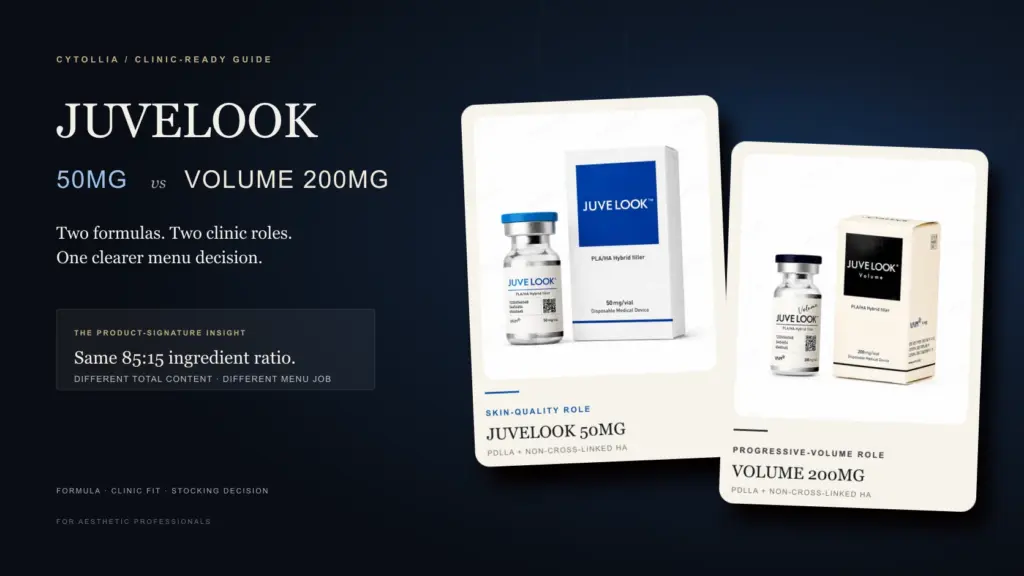
Ask for Juvelook and a supplier may show you two very different numbers: 50mg and 200mg. That makes the range look simple—one standard product and one stronger version. It is also where many clinic menus go wrong. If Volume is sold only as “more Juvelook,” the team has no clear reason to recommend one product over the other, and purchasing has no clear reason to keep both on the shelf.
The better way to read the range is as two separate service conversations. One begins with skin-quality refinement. The other begins with progressive volume support. The formulas are related, but the client job, consultation language and inventory decision should not be the same.
Quick answer
Juvelook 50mg and Volume 200mg are not an entry product and its upgrade
Both products combine PDLLA and non-cross-linked HA in the same 85:15 ratio. Juvelook 50mg contains 42.5mg of PDLLA and 7.5mg of HA; Juvelook Volume 200mg contains 170mg of PDLLA and 30mg of HA. Volume carries four times the total material, but that multiplier cannot be applied to efficacy or value.
A clinic should stock both only when it can support two recurring, clearly different conversations: skin-quality refinement for Juvelook 50mg and progressive volume restoration for Volume 200mg. If both would be sold as the same vague “collagen booster,” one focused SKU is the smarter starting point.
This guide compares product composition, published evidence and clinic-menu fit. Exact product selection remains a professional decision for the individual client and local market.
The numbers look like an upgrade ladder. They are not.
The manufacturer lists the 50mg product as 42.5mg PDLLA plus 7.5mg HA. Volume is listed as 170mg PDLLA plus 30mg HA. In both cases, PDLLA represents 85% of the stated contents and HA represents 15%.
| Published field | Juvelook 50mg | Juvelook Volume 200mg |
|---|---|---|
| Total stated contents | 50mg | 200mg |
| PDLLA | 42.5mg | 170mg |
| Non-cross-linked HA | 7.5mg | 30mg |
| Calculated ingredient ratio | 85% PDLLA / 15% HA | 85% PDLLA / 15% HA |
| Cytollia pricing | Different live price points; check each product page for current pricing | |
This distinction matters because “200mg” is easy to turn into an upsell. A larger number can sound more advanced before anyone has defined the problem it is supposed to solve. Cytollia’s view is simpler: the product with the larger label earns a place only when it supports a genuinely different service, not when it is used to make the standard option look incomplete.
Two products need two different clinic promises
Online descriptions often debate whether Juvelook is a skin booster, a filler or a collagen stimulator. For a clinic menu, the label matters less than the promise being made to the client. If the same words describe both products, the range has not been translated into a usable offer.
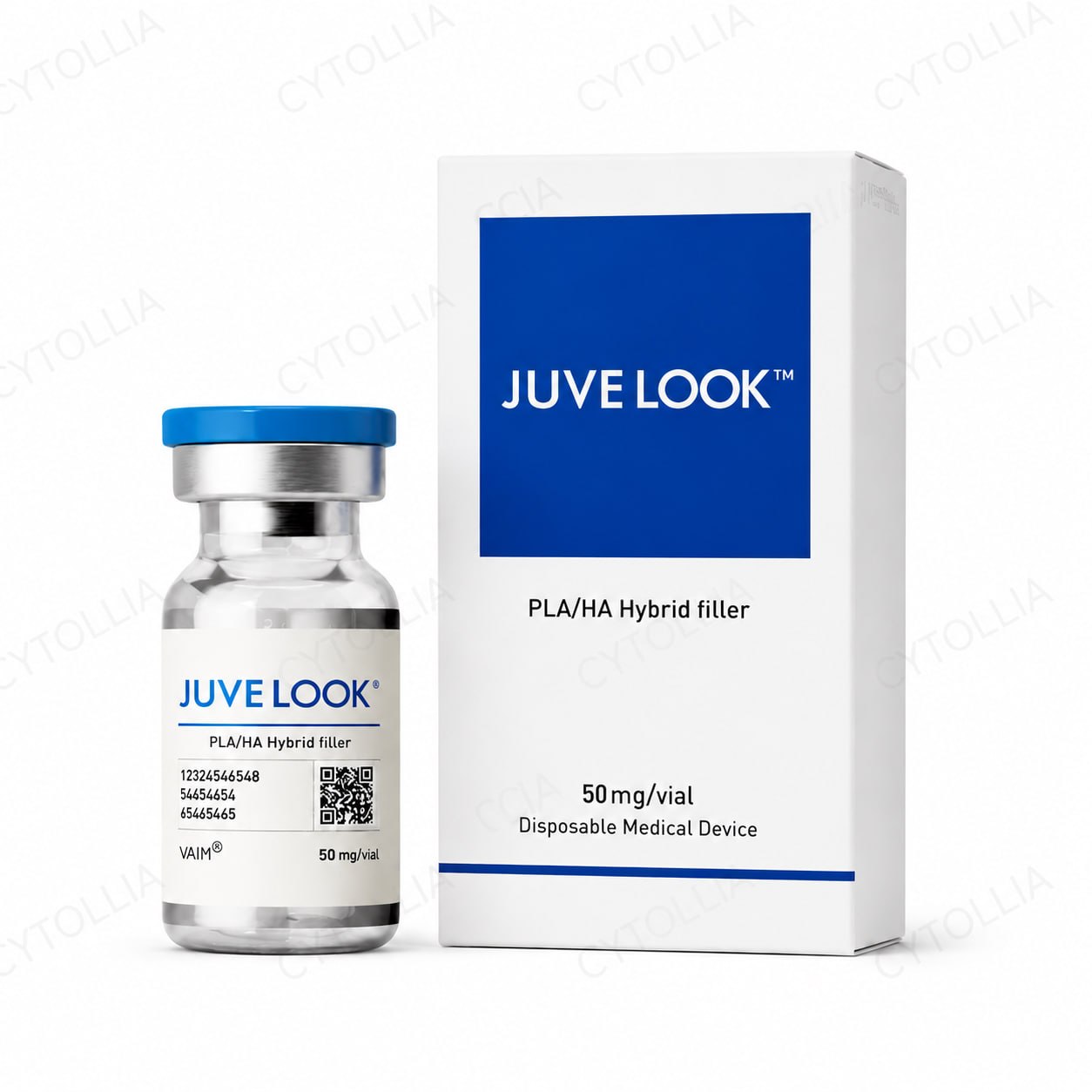
Juvelook 50mg
The skin-quality conversation
This is the clearer starting point when the clinic’s demand centers on overall refinement: texture, fine lines and a skin-quality service rather than a structural-volume menu. The value is not “less product.” It is a more focused promise.
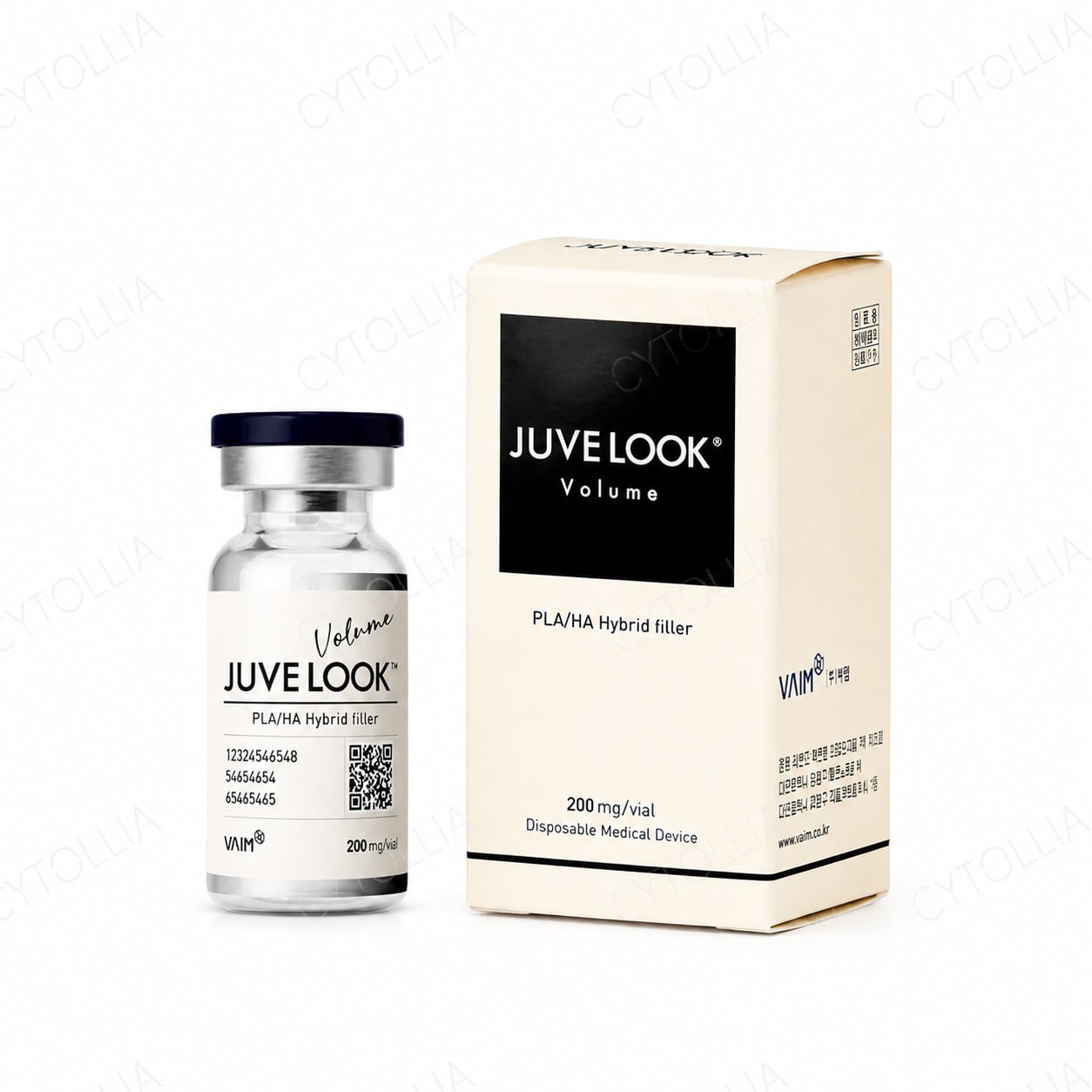
Juvelook Volume 200mg
The progressive-volume conversation
Volume belongs to a different menu discussion: clients whose concern includes visible loss of volume and who are considering a gradual regenerative approach. It should not be presented as the premium tier of the same skin-quality treatment.
That separation is commercially useful. It gives the front desk a cleaner first question, gives the practitioner a clearer consultation path and lets purchasing see whether each product has its own demand. It also prevents a client who asked for “Juvelook” from being moved automatically toward the bigger number.
Clinic Fit Map: stock one or stock both?
A complete-looking shelf is not the goal. A product should be stocked because it supports a repeatable service that the clinic can explain and sell—not because the range has two boxes.
Start with Juvelook 50mg. When most relevant consultations begin with texture, refinement and general skin quality, one focused product is easier to train, position and reorder.
Build around Volume 200mg. This makes more sense when the clinic already sees recurring demand for gradual volume support and can distinguish it from conventional HA filler services.
Stock both. The pair earns separate shelf space when skin-quality and progressive-volume consultations already occur often enough to create independent reorder signals.
Choose one for now. If the team cannot explain the difference without quoting milligrams, two products will compete for the same client rather than expand the menu.
Stocking both is not automatically more sophisticated. It creates two sets of training, consultation and purchasing expectations. The benefit appears only when the second product fills a gap the first cannot explain.
The price gap is not the product decision
Cytollia lists Juvelook 50mg and Juvelook Volume 200mg at different live price points. This guide intentionally does not reproduce fixed amounts because product pricing and tier offers can change. The two product pages remain the source for current pricing.
The products occupy different price points. Verify both live listings before ordering.
The tempting calculation is cost per milligram. It is also the wrong purchasing conclusion. The two products support different services, and a milligram does not represent a treatment, a client outcome or a unit of revenue. A cheaper cost per milligram cannot rescue a product that the clinic cannot position or turn over.
The better commercial question is: does the price difference open a different, recurring service conversation? If yes, Volume can add a new role. If not, the larger vial is simply additional inventory attached to an unclear promise.
Explain the difference without selling milligrams
A clinic should be able to explain the two roles in ordinary language before adding both products to its menu. The explanation does not need to be technical, but it must be different.
For Juvelook 50mg: “This option is considered when the plan focuses on overall skin quality and refinement rather than building a structural-volume service.”
For Juvelook Volume 200mg: “Volume belongs to a different regenerative menu role, where the goal includes gradual volume support. It is not simply a stronger version of the same treatment.”
These statements keep the conversation centered on the client’s goal and the practitioner’s assessment. They also stop the product name from becoming the decision. When someone asks, “Which Juvelook is better?”, the useful answer is not 200mg. It is the product whose role matches the problem being discussed.
The evidence is product-specific—not a license to rank the two
A 2024 preliminary study evaluated the 42.5mg PDLLA plus 7.5mg HA formulation in 16 Korean participants seeking skin rejuvenation. Investigators reported changes in several assessed skin-aging signs and increased collagen and elastic fibers on histology. The study was small, single-arm and supported by VAIM, so it is useful product context rather than a universal promise.
A separate multicenter, randomized, split-face, evaluator-blinded study followed 33 participants and compared Juvelook Volume—170mg PDLLA plus 30mg HA—with injectable PLLA for nasolabial-fold correction. Both sides improved through 24 weeks, and the authors reported non-inferiority for the PDLLA/HA product while calling for longer-term safety research.
What is still missing is a head-to-head trial of Juvelook 50mg versus Juvelook Volume 200mg. The available research supports two product-specific evidence stories; it does not prove that the larger formulation is better, lasts longer for every client or replaces the smaller one.
Before adding the second Juvelook SKU
Purchasing can make the decision clearer with five questions:
- Do two different client concerns appear often enough? One should begin with skin quality; the other should genuinely include progressive volume support.
- Can the team explain the difference in twenty seconds? If the answer relies only on 50mg versus 200mg, the menu is not ready.
- Will each product have its own consultation path? Different roles should be visible in the service description, not hidden behind one generic booster name.
- Can usage and reorders be tracked separately? A second SKU needs its own demand signal instead of borrowing the success of the first.
- Does the live price still support the role? Recheck availability, tier pricing and landed cost at the time of purchase.
If the clinic cannot answer the first three questions clearly, stocking one product is not a compromise. It is a more disciplined menu.
Frequently asked questions
Is Juvelook Volume four times stronger than Juvelook 50mg?
No. Volume contains four times the total stated material, but milligrams do not translate into a four-times efficacy score. The products support different roles, and there is no head-to-head trial proving that Volume is universally stronger or better.
Are Juvelook and Juvelook Volume the same product?
They share PDLLA and non-cross-linked HA in the same calculated 85:15 ratio, but the stated quantities differ: 42.5mg + 7.5mg versus 170mg + 30mg. They should be treated as related products with different menu purposes.
Is Juvelook a skin booster or a filler?
Commercial language varies. Juvelook 50mg is commonly positioned around skin quality, while Volume is discussed in a progressive-volume context. For purchasing and consultation, use the exact product name and intended service role rather than relying on one broad category label.
Does a clinic need to stock both?
No. Stock both only when the clinic has recurring demand for two distinct services and the team can explain them separately. If both products would be sold as the same collagen-booster treatment, start with the one that matches the stronger demand.
Do Juvelook 50mg and Juvelook Volume cost the same?
No. Cytollia lists the two products at different live price points. This guide avoids fixed amounts so it remains accurate when prices or tier offers change. Check each product page for current pricing before ordering.
Which product lasts longer?
The reviewed evidence does not provide a direct 50mg-versus-200mg duration comparison. Fixed longevity claims would ignore the exact product, treatment plan and individual response. Clinics should set expectations from current product documentation and professional assessment rather than the larger number.
Current Cytollia products
Build the Juvelook menu around demand—not the larger number
Review the exact product, current availability and live tier pricing before deciding whether your clinic needs one role or both.
Sources and editorial note
- VAIM / Juvelook official product lineup and composition
- VAIM / Juvelook technology overview
- Seo et al. Skin rejuvenation effect of combined PDLLA and non-cross-linked HA. Journal of Cosmetic Dermatology, 2024.
- Randomized split-face study of Juvelook Volume and injectable PLLA for nasolabial folds, 2026.
Last verified: July 31, 2026. Cytollia sells both products discussed in this guide. The comparison uses current manufacturer information, published research and Cytollia’s live product listings. It does not determine clinical superiority. Current prices and availability are maintained on the product pages.
