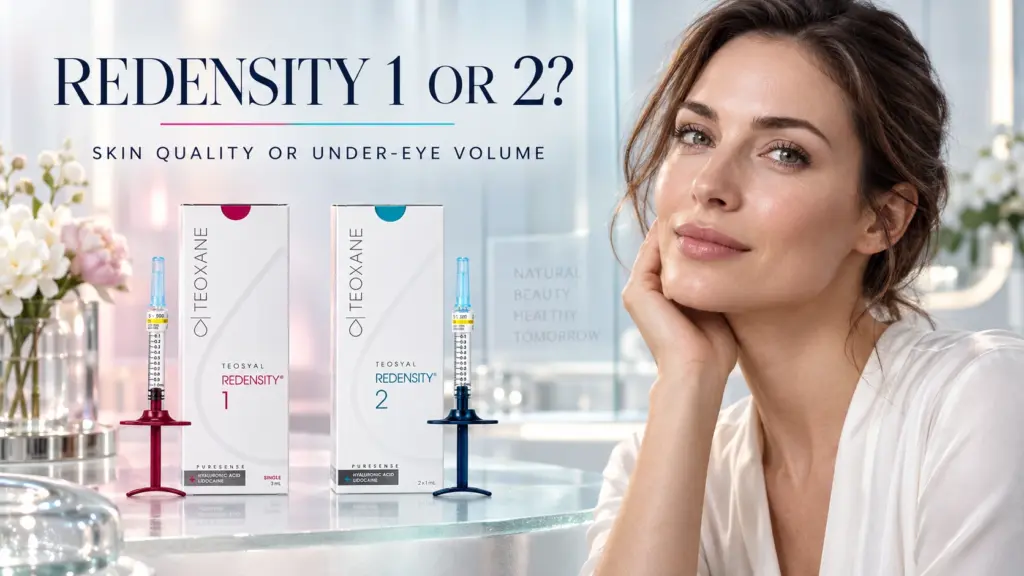
The easiest way to choose between Teosyal Redensity 1 and Redensity 2 is to stop looking at the number and look at the result the client wants. If she wants her complexion to feel less thirsty, reflect light more evenly and look smoother in makeup, Redensity 1 is the relevant conversation. If her face looks tired because a definite hollow sits beneath the eye, Redensity 2 is the product designed to restore that missing contour.
They belong to the same Teosyal family, but they are not two strengths of one treatment. Redensity 1 works on skin quality. Redensity 2 works on under-eye volume. Once that distinction is clear, the choice becomes much easier for the client, the practitioner and the clinic buyer.
Choose by the mirror problem
Start with what the client sees, not what the box says
Most clients do not arrive asking for a non-crosslinked gel or a periocular filler. They say that their skin looks flat even after a good routine, that foundation catches on fine texture, or that the hollow under their eyes makes them look tired after a full night’s sleep. Those are different mirror problems, and they need different product stories.
| What the client says | What she actually wants to change | The relevant Redensity route |
|---|---|---|
| “My skin is hydrated in the morning but looks flat again by afternoon.” | More lasting suppleness and better light reflection across the complexion | Redensity 1 |
| “My face looks dull and finely creased, especially when I wear makeup.” | Smoother-looking texture, bounce and an overall fresher finish | Redensity 1 |
| “There is a groove under my eye that concealer cannot hide.” | A smoother transition between the lower eyelid and upper cheek | Redensity 2 |
| “I always look tired because the under-eye hollow casts a shadow.” | Controlled volume where the tear trough has lost support | Redensity 2 |
This is why a useful Teosyal Redensity 1 vs 2 guide cannot be a packaging comparison. The products earn their place by solving separate visual concerns.
The skin-quality route
Redensity 1 is the skin-quality member of the family
Redensity 1 is for the client who is not trying to change the shape of her face. She wants skin that looks better in ordinary life: more supple in daylight, smoother beneath makeup and less visibly depleted around fine surface lines.
Teoxane describes Redensity 1 as a fluid hyaluronic-acid product that distributes evenly to improve hydration, texture and elasticity. That fluidity is central to its role. It is intended to spread through a broader skin area rather than sit in one place to create projection or rebuild a contour.
The visible result is best described as better-quality skin, not added facial volume:
- a more hydrated, comfortable-looking complexion;
- smoother light reflection across dry or finely textured areas;
- improved-looking elasticity and softness;
- a fresher finish across the face, neck or décolletage;
- skin that looks plumper from hydration without appearing sculpted.
For a clinic, this makes Redensity 1 easy to position as a full-complexion skin-quality service. It belongs in the same client conversation as glow, bounce and texture—not cheek projection, lip shape or tear-trough filling.
There is also a useful evidence layer behind that positioning. In the prospective multicentre SKINQARE study, Redensity 1 was added after an initial RHA 1 treatment. Participants reported that firmness, smoothness, bounce and a refreshed feeling lasted longer after the sequential plan, and the “very satisfied” rate increased at the later follow-up. Because the study assessed a sequence, its results should not be presented as a stand-alone Redensity 1 trial. What it does support is the product’s intended role in a broader skin-quality strategy.
Not a different face—a better-looking surface.
Think hydration, light reflection, softness, fine texture and the healthy-looking bounce clients notice when their makeup sits more smoothly.
The eye-contour route
Redensity 2 is built for the under-eye contour
An under-eye hollow changes the way light travels across the face. The depression creates a shadow between the lower eyelid and the upper cheek, so the client can look tired even when her skin is otherwise healthy. That is a shape problem rather than an all-over hydration problem.
Redensity 2 is the structural member of the pair. Teoxane’s patient information describes it as creating volume within the under-eye cavity while correcting fine lines and wrinkles. Its job is not to refresh the whole complexion; it is to make the eye-to-cheek transition look smoother and more rested.
For the right concern, the change is easy for a client to understand:
- the tear-trough groove looks softer;
- the shadow created by the hollow becomes less dominant;
- the eye contour appears smoother and better supported;
- the face can look more rested without looking dramatically altered.
The distinction between a hollow and skin colour matters. Redensity 2 can soften a shadow created by missing volume; it is not a skin-brightening product for every type of dark circle. Framing the result this way keeps the promise clear and makes the improvement easier to recognise.
The latest real-world evidence is directly relevant to this role. The EYELIGHT study enrolled 136 subjects and evaluated Redensity 2 across the tear trough and wider periocular area. In Teoxane’s summary of the published study, more than 75% of participants showed visible aesthetic improvement at three months, more than 80% reported satisfaction, and results were observed for up to 12 months. That gives clinics a product-specific evidence story rather than relying only on general claims about under-eye filler.
A rested eye contour without changing the client’s identity.
The visual goal is a softer hollow and a smoother lower-eyelid-to-cheek transition, not an overfilled or obviously treated look.
The difference beneath the name
Why the formulas create two different kinds of result
The science can be explained without turning the consultation into a chemistry lesson. Redensity 1 uses non-crosslinked hyaluronic acid with marked fluidity. In plain language, it is made to distribute and improve the quality of a wider skin area. The hydration is part of the result, while the client’s facial structure remains the same.
Redensity 2 combines crosslinked and non-crosslinked hyaluronic acid. The crosslinked portion gives the gel enough presence to replace controlled volume, while the fluid portion supports integration in the delicate eye contour. That is why it can address a depression that Redensity 1 is not designed to fill.
The shared family name reflects Teoxane’s broader hyaluronic-acid and skin-quality approach. The different structure explains why the products should never be introduced as interchangeable versions of the same treatment. If the wider distinction between skin boosters and fillers is still unclear, Cytollia’s guide to what a skin booster and a filler can—and cannot—do explains that category difference in more detail.
| Decision point | Redensity 1 | Redensity 2 |
|---|---|---|
| Primary job | Improve overall skin quality | Restore controlled under-eye volume |
| The client notices | Dryness, dullness, fine texture or reduced elasticity | A visible tear trough or under-eye hollow |
| The result she watches for | Hydrated bounce, smoother texture and better radiance | A softer groove and more rested eye contour |
| Best clinic-menu home | Skin quality, glow or redensification | Tear trough or eye-contour correction |
| Manufacturer’s expected lifetime | At least three months | At least 12 months |
| Cytollia product route | View Redensity 1 | View Redensity 2 |
A faster consultation decision
Choose by the first thing that catches the eye
If the concern appears across the face—skin looks flat, makeup exposes fine texture, or the complexion has lost its soft bounce—start the conversation with Redensity 1. The improvement should be judged across the skin surface, not by whether a particular hollow disappears.
If the concern stays in one recognisable groove beneath the eye, especially when that groove casts a persistent shadow, Redensity 2 has the clearer role. The improvement should be judged by the contour and the way light moves from the lower eyelid to the cheek.
Some clients notice both. In that case, the answer is still not to force one product to do two jobs. A clinic can treat skin quality and eye-contour volume as separate goals within a professionally assessed plan. That preserves what each product is good at and gives the client two clear ways to recognise progress.
FOR SKIN QUALITY
Teosyal PureSense Redensity 1
Choose the skin-booster route for hydration, texture, elasticity and an overall fresher finish.
View Redensity 1 →
FOR UNDER-EYE VOLUME
Teosyal PureSense Redensity 2
Choose the periocular-filler route for a tear-trough depression and a smoother eye contour.
View Redensity 2 →
What people already ask
The questions clients and clinic buyers are already asking
Is Teosyal Redensity 1 a filler?
It sits within Teoxane’s injectable hyaluronic-acid portfolio, but its practical role is a skin booster, not a structural volumizer. Redensity 1 is designed to distribute through the skin and improve hydration, texture and elasticity rather than build a cheek, lip or tear-trough contour.
What is Teosyal Redensity 2 used for?
Redensity 2 is designed for the under-eye cavity and wider periocular contour. Its clearest role is restoring controlled volume to a tear-trough hollow so the transition from the lower eyelid to the cheek looks smoother and less tired.
Does Redensity 1 add volume under the eyes?
Redensity 1 can make skin look plumper because better-hydrated skin reflects light differently, but it is not intended to replace the structural volume missing from a definite tear-trough depression. That is the role that separates Redensity 2 from Redensity 1.
How long do Redensity 1 and Redensity 2 last?
Teoxane’s current patient information lists an expected lifetime of at least three months for Redensity 1 and at least 12 months for Redensity 2. Individual duration varies, but the difference reinforces their separate jobs: repeatable skin-quality maintenance versus longer-lasting support for a specific contour.
Should a clinic stock both Redensity 1 and Redensity 2?
Yes, when the clinic offers both skin-quality and eye-contour services. They should not be presented as two sizes of the same product. Stocking both makes sense when each has its own consultation language, visible result and menu position.
The clear answer
The number matters because the treatment goal changes
Redensity 1 and Redensity 2 make sense together only after their jobs are separated. One helps a wider area of skin look more hydrated, smooth, elastic and luminous. The other restores volume where an under-eye hollow interrupts the contour and casts a tired-looking shadow.
That is the useful answer behind the search for Teosyal Redensity 1 vs 2. There is no universal winner and no reason to turn the article into a list of box specifications. Start with what the client sees, match it to the correct product role, and make the expected result easy to picture.
For overall skin quality, follow the Redensity 1 product route. For the tear trough and under-eye contour, follow the Redensity 2 product route. Professional suitability should be assessed using the current product information and applicable local requirements.
Evidence and disclosure
Sources and editorial disclosure
- Teoxane — Product information for patients
- Teoxane — Current instructions-for-use index for Redensity 1 and Redensity 2
- PubMed — Real-world evidence for Redensity 2 in the periocular region (EYELIGHT)
- Teoxane — EYELIGHT study summary
- PubMed — SKINQARE prospective multicentre sequential-treatment study
Manufacturer information supports the intended product roles and expected lifetimes. EYELIGHT provides product-specific observational evidence for Redensity 2. SKINQARE assessed Redensity 1 as part of a sequential plan, so its outcomes are described within that boundary. Cytollia links are commercial product routes. Results vary, and professional suitability should follow current product documentation and local requirements.
