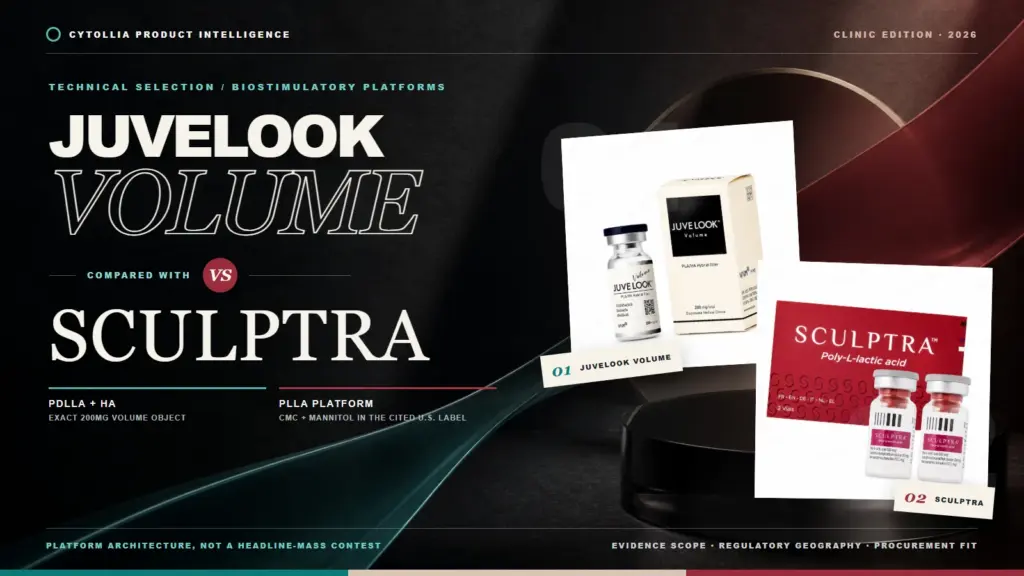
A product-level comparison of PDLLA plus non-cross-linked HA and PLLA plus CMC and mannitol—built around exact identity, evidence limits, regulatory geography and the documentation a clinic needs before either platform enters its shortlist.
Quick answer
Do not choose between these platforms by headline milligrams
Juvelook Volume vs Sculptra is a comparison of two different manufactured platforms, not a 200mg-versus-367.5mg strength contest. Juvelook Volume’s Korean product information lists a 200mg PDLLA-and-HA presentation. The cited U.S. Sculptra label describes a 367.5mg vial containing PLLA microparticles, carboxymethylcellulose and mannitol. Those totals contain different components and cannot be converted into equivalent potency, dose or expected clinical effect.
The practical clinic decision starts with five questions: Is the exact version identified? Does its polymer-and-carrier architecture match the platform under review? Is the evidence direct or borrowed from a related product? Which market’s label applies? Can the supplier, batch, storage and training documentation be verified? A 2026 randomized split-face study gives these exact products useful comparative evidence for nasolabial-fold outcomes through 24 weeks, but it does not establish a universal winner.
Professional education only. This guide does not provide dosing, dilution, reconstitution volume, device, injection plane, technique, aftercare or an individual treatment recommendation. Current market-specific instructions for use and qualified clinical judgment control real-world use.
Version firewall
First confirm the product: Volume 200mg is not Juvelook 50mg
Many search results use “Juvelook” as if it named one formulation. The official Korean product page shows that it does not. Standard Juvelook is listed as a 50mg presentation containing 42.5mg PDLLA and 7.5mg HA. Juvelook Volume is listed separately as 200mg total, comprising 170mg PDLLA and 30mg HA. Different content means different product identity; evidence for the 50mg object cannot silently become evidence for the 200mg Volume object.
Inside this comparison: the named 200mg PDLLA + HA presentation compared directly with Sculptra in the 2026 split-face study.
Outside this comparison: a separate presentation. Use Cytollia’s Juvelook vs Juvelook Volume guide when the real question is version selection.
This naming rule matters whenever a paper, label, brochure or supplier document says only “Juvelook.” Before using the information, verify the component quantities and presentation. If the source studied 50mg, it belongs to the 50mg product record even when the polymer family and brand are shared.
Verified product identity
Composition, supplied form and jurisdiction
Juvelook Volume
PDLLA + non-cross-linked HA
VAIM’s official Korean page identifies Juvelook Volume as a distinct 200mg PDLLA-and-HA product. The direct clinical paper describes the compared PDLLA product as Juvelook Volume and identifies its carrier as non-cross-linked HA. The product is supplied in a lyophilized form and is not a ready-to-use prefilled HA gel.
Scope: the composition and Korean product wording are Korea-specific source facts. They do not prove authorization, indication or permitted sale in another country.
Sculptra
PLLA + CMC + mannitol
The cited U.S. FDA physician labeling describes Sculptra Aesthetic as an injectable implant containing PLLA microparticles, carboxymethylcellulose, non-pyrogenic mannitol and sterile water for injection. It is supplied in a 367.5mg dose vial and requires reconstitution before use.
Scope: these are U.S. label facts. The current target-market IFU must control indications, warnings, permitted professional use and preparation.
Comparison architecture
The technical difference is platform design and evidence scope
The central difference is not simply 200mg versus 367.5mg. A useful collagen biostimulator comparison keeps the complete formulation, supplied form, exact evidence object and regulatory jurisdiction together.
| Field | Juvelook Volume | Sculptra | Procurement question |
|---|---|---|---|
| Current Cytollia object | Juvelook Volume 200mg; product ID 759 | Sculptra two-vial product; product ID 775 | Do the carton, vial, invoice and batch documents match the exact catalog object? |
| Polymer family | PDLLA: poly-D,L-lactic acid | PLLA: poly-L-lactic acid | Is the team selecting a complete product platform rather than an abstract polymer name? |
| Carrier / excipients | Non-cross-linked HA in the cited product evidence | CMC and mannitol in the cited U.S. label | Has the carrier architecture been included in training and document review? |
| Headline mass | 200mg total: 170mg PDLLA + 30mg HA | 367.5mg dose vial containing PLLA, CMC and mannitol | Is anyone incorrectly treating different formulation totals as equal dose or relative strength? |
| Supplied form | Lyophilized presentation; product-specific reconstitution applies | Lyophilized vial; reconstitution required by the U.S. label | Does the clinic possess the current exact IFU and formal training? |
| Direct comparison | Randomized split-face clinical comparison for nasolabial folds through 24 weeks; non-inferiority reported under the study conditions. | Are the indication, population, assessment window and study limitations kept beside the result? | |
| Material evidence | No reviewed physicochemical paper directly characterizes Volume 200mg against Sculptra. | Sculptra was characterized in a paper that used ordinary Juvelook 50mg, not Volume. | Has 50mg laboratory evidence been prevented from migrating into the 200mg record? |
| Official-source geography | Korean official product information | U.S. FDA physician labeling | Which destination-market registration and label actually govern procurement and use? |
Mass firewall
Why 200mg and 367.5mg have no horizontal potency meaning
A vial total is an identity and packaging fact. It is not a standardized unit of clinical power. Juvelook Volume’s 200mg total is explicitly divided into PDLLA and HA. Sculptra’s 367.5mg total includes PLLA microparticles plus CMC and mannitol. The formulations do not have the same component set, so comparing their headline totals is like comparing the gross weight of two instruments built from different parts.
Even isolating polymer mass would not create a valid outcome conversion. Clinical performance can be influenced by the manufactured particle system, carrier, hydration behavior, product handling, treatment context and evidence-supported use. A larger number cannot independently establish more collagen response, more correction, longer duration, fewer complications or a preferred clinical role.
What the numbers can—and cannot—say
They can confirm that the correct presentation is in hand and that its label matches the cited evidence. They cannot determine an equivalent treatment dose, session plan or winner. This article therefore excludes dose-conversion language and directs all preparation and use decisions to the current product-specific IFU and training.
PDLLA vs PLLA
More than a one-letter material difference—but not a shortcut to outcomes
PDLLA contains both D- and L-lactic-acid units, which disrupt regular chain packing and is commonly described as amorphous. PLLA contains the L form and is commonly described as semicrystalline. That material-family distinction is real. Juvelook Volume also uses a non-cross-linked-HA carrier, while the U.S. Sculptra label identifies CMC and mannitol. A clinic is therefore comparing two complete architectures, not interchangeable “collagen powders.”
PDLLA platform
Mixed stereochemistry and an amorphous polymer family. In Juvelook Volume, the named product evidence pairs PDLLA with non-cross-linked HA.
Conceptual material illustration; not a product micrograph and not to scale.
PLLA platform
L-only stereochemistry and a semicrystalline polymer family. The cited U.S. Sculptra formulation includes CMC and mannitol.
Conceptual material illustration; not a product micrograph and not to scale.
A 2025 physicochemical study observed different morphology, size distribution, viscosity and reconstitution behavior among Sculptra and several PDLLA products. However, its Juvelook sample was the ordinary 50mg presentation. The paper states that 50mg of Juvelook powder was the relevant manufacturer presentation; it did not test Juvelook Volume 200mg. Cytollia therefore does not import its Juvelook particle-size, morphology, viscosity or reconstitution measurements into this Volume comparison.
Do not infer
- That a polymer family’s morphology proves better dispersion in every patient.
- That one carrier guarantees a more natural, immediate or durable result.
- That laboratory hydration or viscosity establishes fewer nodules, safer placement or superior correction.
- That standard Juvelook 50mg measurements describe Juvelook Volume 200mg.
For broader material-family context, see Cytollia’s AestheFill vs Sculptra guide. The useful technical habit is to separate what a laboratory measured from what a clinical study demonstrated—and to verify that both sources refer to the exact product being purchased.
Direct clinical evidence
What the 2026 split-face study found—and did not prove
Study reality check
A multicenter, randomized, evaluator-blinded split-face study compared Juvelook Volume with Sculptra in 33 subjects with nasolabial folds and followed outcomes through 24 weeks. Improvement was reported on both sides, and the PDLLA-based product met the study’s non-inferiority analysis. This supports a bounded comparison for that setting—not universal equivalence or superiority.
The design is valuable because each participant received the two products on opposite sides, reducing some between-person variability. Standardized photography and wrinkle-severity assessments were used over the study period. The paper’s conclusion was that the degree of improvement was comparable under its tested conditions and that longer-term safety still requires further study.
- A direct product-to-product clinical comparison, rather than cross-trial speculation.
- Comparable improvement measures for the studied nasolabial-fold setting through 24 weeks.
- Non-inferiority of the PDLLA-based product under the prespecified analysis.
- Among 20 mobile-survey respondents, 70% reported no product preference; the small denominator must remain attached.
- Long-term head-to-head durability beyond the 24-week observation window.
- A universal complication, nodule or safety ranking.
- Area-by-area suitability or performance outside the studied nasolabial-fold context.
- Generalization to all populations: participants were Korean and predominantly women.
- Any claim that either product is clinically superior overall.
The Juvelook Volume Sculptra clinical study also used one defined study protocol. This editorial deliberately omits its injection amounts, timing and procedural details. A published research protocol is not a substitute for the current destination-market IFU, hands-on training, local professional scope or individual assessment.
Funding is part of evidence interpretation. The study lists VAIM Co., Ltd. as the funder, while the authors reported no conflicts of interest. Funding does not invalidate the result, but it should be disclosed alongside the modest sample, limited follow-up and narrow clinical question.
How a procurement team should read “non-inferiority”
Non-inferiority asks a narrower statistical question than “Are these products identical?” or “Which one is better?” It tests whether the study result for one product stayed within a prespecified acceptable boundary relative to the comparator for the chosen endpoint. A successful analysis can support confidence that the tested product did not perform unacceptably worse in that defined setting. It does not erase formulation differences, create dose equivalence or establish interchangeability for other objectives.
For a clinic, the result is best used as one evidence module: both products have direct comparative relevance when the defined question is nasolabial-fold improvement through 24 weeks. The rest of the procurement decision still needs separate modules for local labeling, safety information, professional training, supply quality, storage, service design and the clinic’s follow-up capacity. That is why the same study can place both products on a shortlist without forcing the same final choice in every market or practice.
Technical selection map
When each platform enters the clinic conversation
The matrix below answers the technical question the article is meant to solve: not which product is “best,” but when a named platform has enough relevance to enter an evidence review—and when neither product can be selected from current evidence.
| Clinic condition | Candidate path | Evidence reason | Still confirm | Do not conclude |
|---|---|---|---|---|
| A locally labeled PLLA platform with a mature U.S. regulatory record is required | Sculptra enters the shortlist | A U.S. FDA PMA record and physician labeling are publicly available for the named Sculptra platform. | Actual target-market label, permitted sale, team qualification and training. | U.S. labeling does not create worldwide authorization or suit every clinical objective. |
| The clinic specifically requires the PDLLA + non-cross-linked HA 200mg architecture | Juvelook Volume enters the shortlist | Official Korean information identifies the composition, and the exact product appears in the direct clinical comparison. | Target-market registration, IFU, supplier chain, batch documents and training. | The HA carrier does not by itself prove immediate correction, better integration or safer outcomes. |
| The evidence question is limited to nasolabial-fold outcomes through 24 weeks | Both can enter evidence review | The randomized split-face study directly compared the two products and reported non-inferiority under those conditions. | Whether the study population and endpoint answer the clinic’s real use case. | The result does not name a universal winner or establish long-term equivalence. |
| The real concern is fine texture, pores, superficial lines or ordinary Juvelook 50mg | This comparison is the wrong decision page | Juvelook 50mg is a separate product object with different content and its own evidence record. | Exact version and area-specific clinician assessment. | Do not choose Volume because its mass is larger or transfer 50mg evidence to it. |
| Long-term comparative durability, area-specific use or a complication ranking is required | Neither can be selected from the current head-to-head evidence alone | The direct comparison ends at 24 weeks and does not answer every area or safety question. | Current product-specific studies, IFUs, safety notices and licensed review. | No “lasts longer,” “fewer nodules,” “safer” or “best area” claim is established here. |
| The current IFU, legal-market confirmation, batch traceability or trained clinician is missing | Neither should enter procurement | Editorial relevance cannot replace legal, quality and professional controls. | All missing documentation before purchasing or clinical planning. | Availability on a website is not enough to establish compliant procurement or use. |
Documentation burden can legitimately change the first product investigated. A clinic working inside the U.S. may begin with Sculptra because the applicable FDA record and physician label are accessible, while a clinic in another jurisdiction may have a different approved pack, indication or supplier pathway. A clinic considering Juvelook Volume may value its specific PDLLA-plus-HA architecture, but that preference becomes actionable only when local registration, IFU and traceability evidence are available. This is a compliance-and-evidence distinction, not a claim that either formulation produces a better clinical result.
Evidence maturity and geography
“Approved somewhere” is not a global regulatory status
Sculptra has a publicly accessible U.S. FDA PMA history and U.S. physician labeling. That is a meaningful evidence and documentation advantage when the clinic’s question is specifically about the U.S. regulatory record. It does not establish the current indication, packaging or permitted professional use in every other country.
Juvelook Volume’s cited official facts come from VAIM’s Korean product page, including the 200mg composition and Korean intended-purpose wording. This article does not claim that Juvelook Volume is U.S. FDA-approved, because no current official FDA record supporting that statement was supplied. Korean authorization likewise should not be rewritten as global authorization.
Dated label check · 19 August 2026
Juvelook Volume: Korean official product page supports version and composition. Sculptra: U.S. FDA labeling supports composition, vial total, lyophilized form, reconstitution requirement, U.S. professional-use limits, warnings and precautions. Before publication or procurement, refresh both sources and obtain the current destination-market IFUs.
Regulatory review must match the country where the product will be sold and used, the intended purpose, the pack being sourced and the professional role involved. A clinic procurement guide can organize that check; it cannot complete it.
Before-you-stock checklist
Seven controls before either platform joins a clinic menu
Exact object
Match brand, version, component amounts, vial count and manufacturer across the product, carton, invoice and evidence record.
Local IFU
Obtain the current target-market instructions in a language the team can use; verify intended purpose, warnings, storage and professional limits.
Legal-market evidence
Confirm registration or other permitted-sale documentation for the destination market and channel instead of relying on another country’s label.
Traceability
Record supplier identity, authorized supply path where applicable, batch or lot, expiry, authenticity controls and recall contact.
Storage and shelf life
Verify the current label requirements and whether the actual logistics chain can maintain them through receipt and clinic storage.
Training and scope
Confirm qualified clinicians, product-specific training, governance, consent and adverse-event reporting before clinical use.
Menu overlap
Define why this platform is needed alongside existing AestheFill, Radiesse or other biostimulatory options; see Cytollia’s Radiesse vs Sculptra guide for another material-family decision.
This biostimulator clinic procurement checklist intentionally excludes fixed price and promised inventory. Both Cytollia objects were present and purchasable when research was checked, but availability can change and must be refreshed on the publication or ordering day.
Safety and editorial boundary
Use each product’s own safety information
Both platforms belong under trained, licensed professional control and the current market-specific IFU. Warnings from Sculptra’s U.S. label should not be copied onto Juvelook Volume as if they were its approved label; a thinner public source for one product should not be mistaken for lower risk.
This guide does not claim that either product is safer, more natural, stronger, longer-lasting, better for an anatomical area or less likely to form nodules. Those rankings require direct product-, indication-, population- and market-specific evidence that the current comparison does not provide.
Clinic FAQ
Questions teams ask about Juvelook Volume vs Sculptra
Is Juvelook Volume the same as Juvelook 50mg?
No. The official Korean product page lists Juvelook 50mg and Juvelook Volume 200mg as different presentations with different component quantities. Evidence, labels and procurement records must name the exact version. This article compares Volume 200mg only.
Is Juvelook Volume’s 200mg directly comparable with Sculptra’s vial mass?
No. The totals contain different components: Juvelook Volume’s official Korean information lists PDLLA plus HA, while the cited U.S. Sculptra label lists PLLA, CMC and mannitol. Headline mass does not establish equivalent dose, potency or outcome.
What is the practical material difference between PDLLA and PLLA?
PDLLA contains D- and L-lactic-acid units and is generally amorphous; PLLA contains the L form and is generally semicrystalline. The products also have different carriers. These facts shape a technical review but do not independently prove comparative clinical performance.
Did the 2026 split-face study prove one product is better?
No. It reported comparable improvement and non-inferiority for the studied nasolabial-fold outcomes through 24 weeks. It did not establish universal superiority, long-term equivalence, performance in every anatomical area or a comparative safety ranking.
Does Juvelook Volume require reconstitution?
Yes, it is a lyophilized presentation rather than a ready-to-use prefilled gel. This article does not provide a reconstitution recipe. Clinics should use the current exact, target-market IFU and product-specific training rather than a competitor summary or research protocol.
Which product should enter a clinic’s shortlist?
Sculptra enters when a locally applicable PLLA platform and its regulatory record fit the requirement. Juvelook Volume enters when the exact PDLLA-plus-HA 200mg architecture is required. Either still needs local authorization, documentation, training and use-case fit.
Is regulatory status the same in every country?
No. This guide cites U.S. FDA labeling for Sculptra and Korean official product information for Juvelook Volume. Neither source should be exported into a global approval claim. Verify the destination market, indication, sales channel and current IFU.
Can this comparison replace the current IFU or product training?
No. It is an evidence map for professional procurement discussion, not procedural instruction. Current IFUs, local law, formal training, qualified clinical judgment, patient-specific assessment and clinic governance remain mandatory controls.
Procurement conclusion
Choose the documented platform—not the bigger number
Juvelook Volume and Sculptra can both enter a clinic’s evidence review when the question matches the exact products and the 24-week nasolabial-fold comparison is relevant. The choice then turns on polymer-and-carrier architecture, target-market label, evidence maturity, supply traceability, team training and menu fit. If the clinic needs claims beyond those boundaries, the available head-to-head evidence is not enough.
Review the cited labels and product-level study, then confirm current market documentation and live availability before adding either platform to a clinic menu.
Primary sources and review notes
- VAIM / Juvelook official Korean product page — product lineup, Juvelook 50mg and Juvelook Volume 200mg composition, and Korean product wording.
- U.S. FDA Sculptra Aesthetic physician labeling — U.S. device description, 367.5mg vial total, supplied form, reconstitution requirement, warnings and precautions.
- U.S. FDA PMA record P030050 — U.S. regulatory history and label context.
- Park et al., 2026, randomized split-face study — direct Juvelook Volume and Sculptra comparison for nasolabial folds through 24 weeks.
- Full text of the split-face study — methods, results, funding, respondent denominator and limitations.
- Su et al., physicochemical characterization — polymer background and laboratory measurements; the tested Juvelook object was 50mg, so its product measurements are not attributed to Volume 200mg.
Sources and the current Cytollia product objects were checked on 19 August 2026. Labels, registrations, pack formats, safety notices and availability may change. A licensed medical reviewer familiar with the target market has not yet been recorded; the publication-day source refresh was completed on 19 August 2026; medical review remains an open gate before clinical reuse.
Commercial disclosure: Cytollia lists both products and therefore has a commercial interest in this topic. This editorial draft contains no direct product-purchase links, fixed price, inventory promise, authorization claim, manufacturer endorsement or claim that either product is clinically superior.
