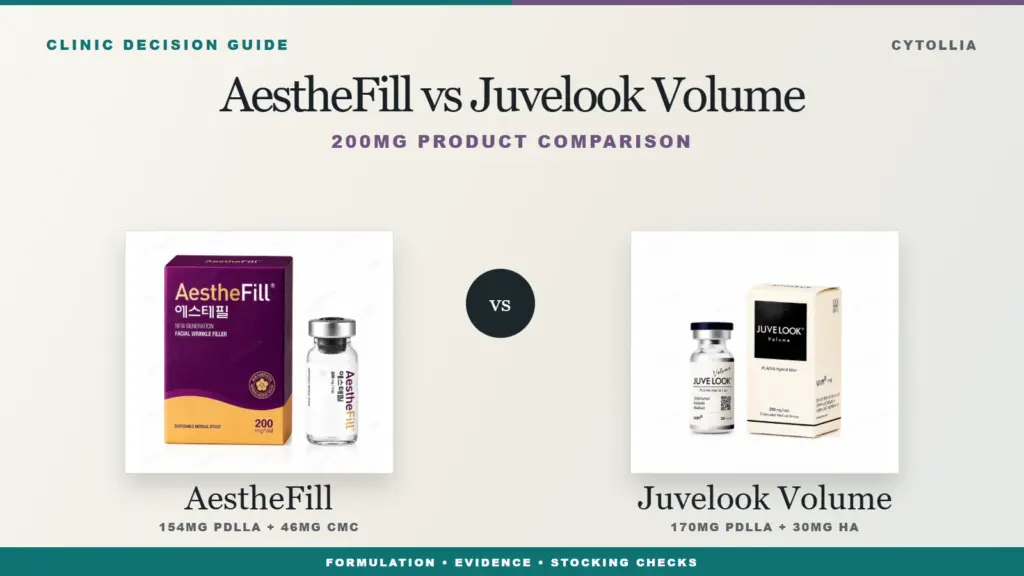
AestheFill 200mg and Juvelook Volume 200mg are reasonable products to place in the same clinic procurement conversation—but the shared “200mg” label does not make them equivalent. Both are lyophilized PDLLA-based presentations. AestheFill combines 154mg of PDLLA with 46mg of carboxymethylcellulose, while Juvelook Volume combines 170mg of PDLLA with 30mg of non-crosslinked hyaluronic acid.
This guide compares those exact product objects. It does not merge Juvelook Volume with standard Juvelook 50mg, convert different clinical trials into a leaderboard, or provide a preparation or injection protocol. The practical question is not simply “Which one is better?” It is whether a clinic can document the formulation, evidence, local label and supply route for the exact vial it is considering.
Quick answer
Two 200mg vials, two distinct formulation platforms
AestheFill 200mg is documented as 154mg PDLLA plus 46mg CMC. Juvelook Volume 200mg is documented as 170mg PDLLA plus 30mg non-crosslinked HA. The number on the vial describes the total supplied formulation, not an interchangeable dose, equal polymer load or guaranteed clinical effect.
There is no direct AestheFill-versus-Juvelook-Volume clinical trial in the evidence reviewed for this guide. Each product has product-specific clinical research, but the studies used different comparators, designs, populations and follow-up periods. Their outcomes should be read independently.
In practical selection, predominantly superficial skin-quality concerns point away from this 200mg comparison and back toward exact products such as standard Juvelook 50mg. Structural volume loss, laxity and deeper folds are the situations in which both 200mg products can enter the same evaluation. A requirement for immediate, predictable gel correction calls for a different product-category comparison.
Professional product education only. The current instructions for use, market authorization, qualified clinical judgment and product-specific training must control any real-world use.
Exact product identity
What is inside each 200mg presentation?
AestheFill 200mg presentation
PDLLA + CMC
REGEN Biotech identifies AestheFill as an injectable poly-D,L-lactic acid product. Humedix’s Korean product information specifies the 200mg vial as 154mg of porous PDLLA microparticles with 46mg of CMC. The supplied material is a lyophilized powder rather than a ready-to-use HA gel.
CMC is part of the product formulation. Its presence should not be reduced to a marketing footnote, because a clinic is assessing the complete vial—not an abstract material called “PDLLA.” Polymer amount, carrier, manufacturing, label and supplied documentation form one product identity.
Juvelook Volume 200mg presentation
PDLLA + non-crosslinked HA
VAIM’s official Juvelook product page separates Juvelook Volume from the lower-content Juvelook presentations. It identifies the Volume product as a 200mg PDLLA-and-HA formulation containing 170mg of PDLLA and 30mg of HA. The 2026 Juvelook Volume clinical paper describes the HA component as non-crosslinked.
This is not standard Juvelook 50mg in a larger-looking box. The named version, total content and component amounts are different. Any evidence citation, procurement record or product comparison should therefore say “Juvelook Volume 200mg” rather than relying on the family name “Juvelook.”
AestheFill vs Juvelook Volume at a glance
The documented comparison—and the question behind each field
| Field | AestheFill 200mg | Juvelook Volume 200mg | Clinic question |
|---|---|---|---|
| Manufacturer | REGEN Biotech, Inc. | VAIM Co., Ltd. | Do the supplier documents identify the same manufacturer, product name and presentation? |
| Total vial content | 200mg | 200mg | Is the team comparing total formulation weight rather than assuming equal active-polymer content? |
| PDLLA content | 154mg | 170mg | Does the label for the supplied vial match the product cited in the article or study? |
| Carrier | 46mg CMC | 30mg non-crosslinked HA | Has the complete formulation been evaluated instead of treating both products as generic PDLLA? |
| Presentation | Lyophilized powder | Lyophilized powder | Does the clinic have the current product-specific IFU and training before use? |
| Product-specific clinical study | Randomized trial against HA; 260 participants; 52-week follow-up | Randomized split-face trial against Sculptra; 33 participants; 24-week follow-up | Is each result being kept inside its own comparator, population and follow-up window? |
| Direct AestheFill comparison | Not established. No direct AestheFill 200mg versus Juvelook Volume 200mg clinical trial was found in the reviewed evidence. | Is a cross-trial impression being presented as if it came from one head-to-head study? | |
| Current Cytollia catalog record | Product ID 735 | Product ID 759 | Have current pack, stock, image, lot and supply documents been rechecked before publication or ordering? |
The 200mg trap
Why the same headline number does not create dose equivalence
“200mg” is useful for identifying the presentation, but it does not answer the comparison by itself. AestheFill’s documented 200mg total is divided between 154mg PDLLA and 46mg CMC. Juvelook Volume’s documented total is divided between 170mg PDLLA and 30mg non-crosslinked HA. The products therefore do not contain the same amount of polymer and do not use the same carrier.
Those arithmetic differences are objective. Their clinical meaning is not self-executing. A higher PDLLA mass in one vial does not independently prove a stronger effect, a longer duration, a different safety profile or a preferred treatment role. Such conclusions would require appropriate direct evidence, the applicable label and professional clinical interpretation.
The carrier difference needs the same discipline. CMC and non-crosslinked HA are part of two complete manufactured formulations. It is not valid to isolate the carrier and promise a faster visible result, easier handling or better tissue integration without product-level evidence designed to answer that question.
Keep the specification comparison useful
- Use 200mg to identify the exact presentation—not to describe an interchangeable treatment amount.
- Show the PDLLA and carrier quantities separately so the shared total does not hide the formulation difference.
- Do not translate composition into dose, dilution, injection depth, treatment area or session planning.
- Ask whether the cited document belongs to the exact supplied product and destination market.
Clinical evidence
What each product’s research can—and cannot—tell a buyer
Both products have product-specific human research. That is more informative than relying on polymer theory alone, but it still does not create a direct comparison. The most useful reading method is to compare study architecture first: exact product, comparator, sample, follow-up and disclosed funding. Only then should a clinic consider what a finding means inside that study.
Randomized against hyaluronic acid
A 2024 evaluator-blinded, multicenter randomized controlled trial enrolled 260 participants with moderate-to-severe nasolabial folds. It compared AestheFill PDLLA with an HA control and followed participants for 52 weeks.
- Supports: a sizeable product-specific controlled clinical program in the studied setting.
- Does not support: a claim about Juvelook Volume, or a general ranking of the two products.
- Disclosure: the paper reports no financial support and no potential conflicts of interest.
Randomized against Sculptra
A 2026 multicenter, randomized, split-face, evaluator-blinded study enrolled 33 subjects and compared Juvelook Volume with Sculptra in the nasolabial-fold setting. Follow-up extended to 24 weeks.
- Supports: product-specific evidence against the named PLLA comparator during the observed period.
- Does not support: superiority over AestheFill or a claim about outcomes beyond the study horizon.
- Disclosure: the work was supported by VAIM Co., Ltd.; the authors declared no conflicts.
The numbers cannot be lined up as if they came from one experiment. The AestheFill study and Juvelook Volume study used different controls, designs and follow-up periods. Even when both use familiar scales, cross-trial differences can reflect the population, study conduct, assessment schedule and comparator rather than a true product advantage.
The Juvelook Volume authors themselves call for longer follow-up and further long-term safety research. That makes the current Cytollia listing’s “over two years” duration language unsuitable for this comparison unless a stronger, exact-product source is supplied and reviewed. The AestheFill duration wording also requires product- and market-specific support before reuse.
Version control
A useful laboratory paper tested Juvelook 50mg—not Juvelook Volume 200mg
A recent peer-reviewed physicochemical study directly characterized AestheFill, Sculptra, NeoFilera and Juvelook. It measured properties such as particle morphology, size distribution, reconstitution under the study conditions, osmotic pressure and viscosity. That sounds highly relevant until the exact Juvelook object is checked.
The tested Juvelook object cannot be silently upgraded to Juvelook Volume
The study used standard Juvelook 50mg, documented as 42.5mg PDLLA plus 7.5mg non-crosslinked HA. It did not test Juvelook Volume 200mg. Its Juvelook measurements therefore belong to the 50mg product and must not be imported into a 200mg Volume comparison.
This version distinction is one of the clearest opportunities for Cytollia to add information value: name the exact product every time, and explain why family-level wording can produce a false comparison.
The same paper also warns against jumping from material measurements to clinical outcomes. Even for the products it actually tested, laboratory differences did not establish comparative efficacy, complication rates, durability, ideal treatment areas or interchangeability.
Technical product selection
Start with the tissue problem—not the brand or the 200mg number
A technical comparison becomes useful only after the clinical objective is defined. The first split is between a predominantly skin-quality problem, a structural volume and support problem, and a need for immediate gel-like correction. Those are not three interchangeable reasons to choose the same product.
Fine lines, pores, texture, atrophic acne scars or thin under-eye skin
Do not default to either 200mg product. Standard Juvelook 50mg is the Juvelook-family object with the closer skin-quality and under-eye evidence base.
Volume loss, laxity, deeper folds or contour support
This is the situation in which AestheFill 200mg and Juvelook Volume 200mg can enter the same candidate pool—subject to the exact local IFU.
A predictable, single-session gel-filler effect is the main requirement
Neither lyophilized PDLLA product should be treated as a like-for-like substitute for a prefilled, locally approved crosslinked-HA filler.
When both 200mg products are technically in scope
The next decision is not “which one has more milligrams?” It is which product has the more relevant combination of formulation, evidence object and professional workflow for the problem being assessed.
Randomized evidence + expert consensus
- The documented target is a moderate-to-severe nasolabial fold or another structural facial depression, and the clinic wants the AestheFill PDLLA-and-CMC platform.
- The evidence requirement favors the larger and longer product-specific randomized program in this pair: 260 participants, an HA comparator and 52-week follow-up in the nasolabial-fold setting.
- The clinical review is focused on age-related laxity, tissue restructuring, hypotrophic scars or deeper facial folds. A 2024 Brazilian expert consensus discusses those uses for AestheFill, but this is consensus-level guidance rather than a direct comparative trial.
Technical boundary: the consensus authors disclosed corporate medical-director, speaker and non-financial relationships, and the paper states that clinical trials across AestheFill’s broader aesthetic indications remain limited. Its broader use map should therefore be presented as expert practice guidance, not as proof that AestheFill is superior for those conditions.
Randomized evidence + market positioning
- The documented target is structural volume loss, laxity, sagging, a deeper fold or contour support, and the clinic specifically wants a PDLLA product with a non-crosslinked-HA carrier.
- The evidence requirement favors a product-specific comparison against a PLLA biostimulator: the Juvelook Volume study used a randomized split-face design against Sculptra in the nasolabial-fold setting, with 33 subjects followed for 24 weeks.
- The clinic’s market documents match the 200mg product also called Lenisna in some markets. A current UK professional brochure positions this presentation for volume restoration, laxity and contour work in the subcutaneous-tissue compartment.
Technical boundary: the randomized study was supported by VAIM and directly supports the studied nasolabial-fold setting—not every face area. The broader volume-and-contour map comes from professional product positioning and must be checked against the destination-market IFU.
Situations where this article should not select either 200mg product
- Thin, highly visible under-eye tissue: a 2026 prospective cohort studied standard Juvelook 50mg—not Volume—in 15 women. A separate case report described nodules after Juvelook Volume was used in the tear trough and explicitly identified the larger Volume product as the wrong version for that case. AestheFill expert guidance also says periocular risk and benefit require further study. This article should therefore direct the reader to exact-product, area-specific evidence rather than nominate either 200mg vial.
- Fine lines, enlarged pores, uneven texture or atrophic acne scars as the primary problem: those concerns align more closely with the standard Juvelook 50mg evidence and product positioning. They are not a reason to choose Juvelook Volume simply because it contains more material.
- Body contouring: the AestheFill consensus discusses off-face expert use, but a consensus is not a global label. Juvelook G/GLAM is a separate body-oriented product object and must not be silently replaced by Juvelook Volume.
- Missing IFU, training or supply documentation: neither product should move forward through an editorial shortcut. The technically correct outcome is to pause the selection.
This framework identifies the first product to investigate; it is not a patient-specific prescription. Anatomy, tissue quality, prior procedures, contraindications and market-approved use still belong to qualified clinical assessment and the exact local product information.
Clinic stocking checks
Five documents and decisions to verify before a product enters the clinic
A defensible procurement comparison ends with documentation, not a winner badge. These checks are deliberately product- and market-specific.
Exact label identity
Match the commercial name, manufacturer, 200mg presentation, component amounts, lot and expiry across the vial, carton, invoice and supplied records. “Juvelook” alone is not precise enough.
Destination-market IFU
Request the current approved instructions for the market in which the product will be used. Confirm intended purpose, professional-use limits, warnings, storage and any market-specific restrictions from that document.
Supply-route evidence
Verify the supplier relationship, invoicing entity, traceability path and authenticity process. REGEN publicly directs orders through local distributors or partners and says it has not authorized general online sale outside those routes.
Evidence-to-product match
For every study used in training or patient communication, confirm that the exact product version was studied. Record the comparator, sample, follow-up, funding and stated limitations.
Professional governance
Keep clinical selection, preparation and use under qualified professional review. A procurement article can organize questions, but it cannot replace the current IFU, hands-on training or patient-specific assessment.
Safety and regulatory boundary
Do not use uneven public information to create a safety ranking
Singapore’s Health Sciences Authority documented a vascular-occlusion event involving AestheFill and noted that vascular occlusion leading to blindness is a known risk of dermal fillers. Its investigation found no evidence of a product-related safety or quality issue in the reviewed lot. This is important market-specific safety context, but it does not create a comparative safety conclusion about AestheFill and Juvelook Volume.
What belongs in a clinic review
The exact local warnings, contraindications, adverse-event reporting pathway, provider qualification requirements and product-specific training controls.
What does not belong in this article
Dose, dilution, injection plane, device choice, technique, complication-management instructions or claims that one product has a lower event rate.
Differences in what is publicly accessible should never be mistaken for differences in actual risk. A more detailed open source for one product may simply reflect publication or market access, not a better or worse safety profile.
Clinic FAQ
Questions teams ask when comparing these products
Are AestheFill 200mg and Juvelook Volume 200mg the same strength?
No equivalence can be inferred from the shared total. AestheFill is documented as 154mg PDLLA plus 46mg CMC; Juvelook Volume as 170mg PDLLA plus 30mg non-crosslinked HA. “Strength” would require a defined clinical endpoint and suitable comparative evidence.
Is Juvelook Volume 200mg the same product as Juvelook 50mg?
No. They are separate presentations with different component quantities. Evidence from standard Juvelook 50mg should not be attributed to Juvelook Volume unless the source explicitly studied the Volume product.
When is AestheFill the more relevant product to evaluate first?
When the defined problem is structural facial depression, age-related laxity or a deeper fold and the clinic wants the AestheFill PDLLA-and-CMC platform. Its strongest randomized evidence in this comparison is a 260-participant, 52-week nasolabial-fold study; broader use comes from expert consensus and needs local-label confirmation.
When is Juvelook Volume the more relevant product to evaluate first?
When the defined problem is structural volume loss, laxity, sagging, a deeper fold or contour support and the clinic specifically wants the 200mg PDLLA-plus-non-crosslinked-HA platform. Its strongest direct clinical evidence reviewed here is a 33-subject, 24-week nasolabial-fold study against Sculptra.
What if the main concern is fine lines, pores, acne scars or thin under-eye skin?
Do not default to either 200mg product. Standard Juvelook 50mg has the closer version-specific skin-quality and under-eye evidence. Juvelook Volume should not inherit that evidence, and AestheFill requires its own area-specific IFU and clinical review.
What if the main requirement is immediate, predictable gel correction?
Neither product should be treated as a like-for-like substitute for a prefilled crosslinked-HA filler. Both are lyophilized PDLLA-based products whose selection involves a biostimulatory treatment plan rather than a simple milligram-for-milligram gel replacement.
Is there a direct AestheFill versus Juvelook Volume clinical trial?
No direct head-to-head clinical trial was found in the evidence reviewed for this guide. Each product has research against a different comparator.
Which one lasts longer?
A comparative duration ranking is not established. The strongest direct Juvelook Volume study reviewed followed subjects for 24 weeks, while AestheFill’s trial used a different comparator and followed participants for 52 weeks. Those time windows are not a head-to-head result.
Publication and sourcing gate
Educational publication is approved; commercial linking should wait
REGEN Biotech’s public AestheFill page says the company has not authorized companies to sell the product online or without local official distributors, and directs orders to local distributors or partners. That statement does not determine Cytollia’s actual supplier status. It does make documentary verification necessary before this draft carries purchase links or ordering language.
Current publication scope: evidence-bounded educational comparison approved by the site owner. No licensed medical reviewer is identified, and no authenticity, authorization, regulatory equivalence, fixed availability or ordering claim is made.
Sources and review notes
- REGEN Biotech — AestheFill product information and supply-route notice
- Humedix — AestheFill 200mg composition and Korean product information
- Juvelook official product page — Juvelook and Juvelook Volume composition
- Aesthetic Surgery Journal — randomized AestheFill PDLLA versus HA study
- PubMed — randomized split-face Juvelook Volume versus PLLA study
- PubMed Central — full text of the Juvelook Volume study, including funding and limitations
- PubMed — physicochemical study that tested standard Juvelook, not Juvelook Volume
- Singapore HSA — AestheFill investigation and dermal-filler risk context
- PubMed Central — AestheFill expert consensus, use scenarios, limitations and disclosures
- FILLMED UK — professional Juvelook and Lenisna product-positioning brochure
- PubMed Central — Juvelook Volume tear-trough nodule case and exact-version warning
- Aesthetic Plastic Surgery — prospective Juvelook 50mg tear-trough cohort
- Cytollia — AestheFill versus Sculptra material-platform guide
- Cytollia — Juvelook 50mg versus Juvelook Volume 200mg guide
Sources and the two current Cytollia product objects were rechecked on 17 August 2026. Product availability, labels, regulatory status and permitted supply routes can change and must be rechecked for the target market before procurement or clinical reuse.
Commercial disclosure: Cytollia currently lists both products and therefore has a commercial interest in this comparison. No source reviewed establishes that one product is clinically superior to the other. This draft does not contain an ordering CTA or fixed price.
