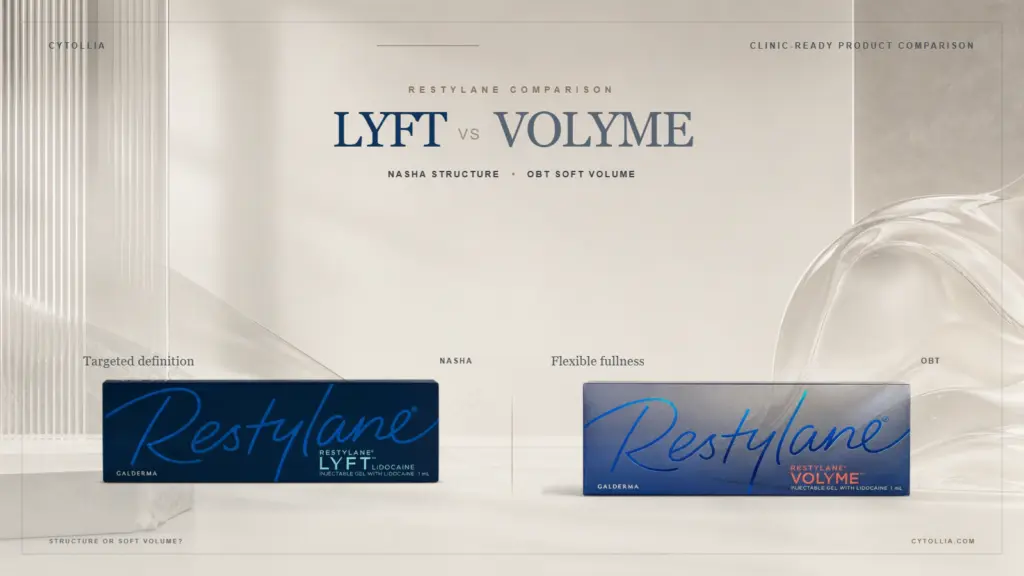
Put Restylane Lyft and Volyme side by side on a purchasing sheet and they can look like duplicate stock. Both publish 20 mg/mL cross-linked hyaluronic acid and 3 mg/mL lidocaine. Both can enter a cheek or midface conversation. Yet a clinic does not sell a concentration—it sells a design decision. The real choice is whether the consultation calls for more targeted structure or a softer form of volume.
That distinction is what gives the two products separate value. If the team describes both simply as “Restylane for cheeks,” price becomes the easiest way to choose and one SKU will eventually cannibalize the other. If the team can explain two different visual jobs, each product can earn a clear place on the menu.
Quick answer
Lyft and Volyme share a concentration, not a job
Restylane Lyft uses NASHA technology and is positioned around a very firm gel, high lifting capacity, structure and projection. Restylane Volyme uses OBT technology and is positioned around moderately soft, flexible volumization and softer cheek fullness. A clinic should choose between them according to the treatment design it wants to offer—not HA concentration alone—and stock both only when both roles appear often enough to justify separate training and reordering.
This comparison translates published product design into clinic-menu and purchasing logic. It does not rank one product as universally superior.
At a glance
What changes—and what does not
| Comparison point | Restylane Lyft | Restylane Volyme |
|---|---|---|
| Gel technology | NASHA | OBT |
| Published composition | 20 mg/mL cross-linked HA; 3 mg/mL lidocaine | 20 mg/mL cross-linked HA; 3 mg/mL lidocaine |
| Published gel positioning | Very firm, with high lifting capacity | Moderately soft, with flexible volumization |
| Primary design question | Does the plan need targeted structure or projection? | Does the plan need softer fullness and contour? |
| Clinic menu role | Structural Definition | Soft-Volume Contouring |
Product DNA
NASHA vs OBT matters only when it changes the design conversation
Technology names are easy to repeat and hard to sell. “NASHA versus OBT” means little to a client and can become another piece of training language that never reaches the consultation. The useful translation is simpler.
Galderma describes NASHA as engineered for precision and structure, with a firm gel texture intended for more pronounced lift and targeted projection. It describes its flexible gel platform—called OBT in many markets and XpresHAn in the United States—as designed around movement, expression and integration. Within the international Restylane range, Lyft sits at the very firm end of the conversation, while Volyme is described as moderately soft and used for volumizing treatments.
This does not create a crude “strong versus weak” ladder. Firm products can still support natural-looking design, and softer products can still contribute shape. The technologies describe different ways to solve a facial design problem. That is more useful than treating Volyme as a cheaper, gentler or less capable version of Lyft.
Customer concern map
One request for “cheek filler” can hide two different jobs
A client asking for “more cheek” may be describing a wish for clearer architecture, or a wish to replace softness and fullness. Those goals can overlap, but they are not the same starting point. When the clinic separates them early, the product choice becomes easier to explain and the quote feels intentional rather than brand-led.
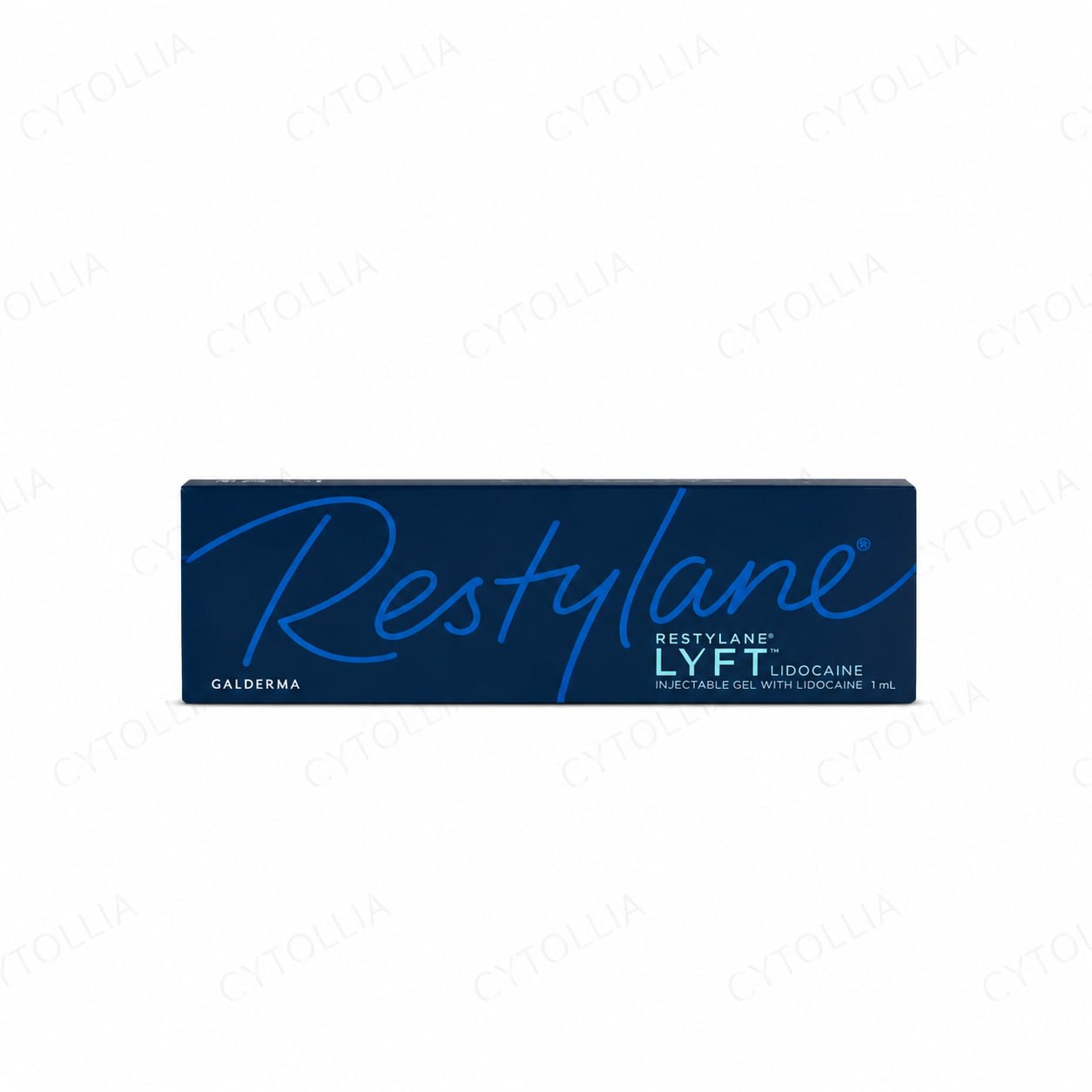
Restylane Lyft · NASHA
The structure conversation
The client language is definition, projection, shape or a clearer structural endpoint. Lyft becomes relevant because its product story is built around firmness, lifting capacity and targeted projection—not because the number on the label is higher.
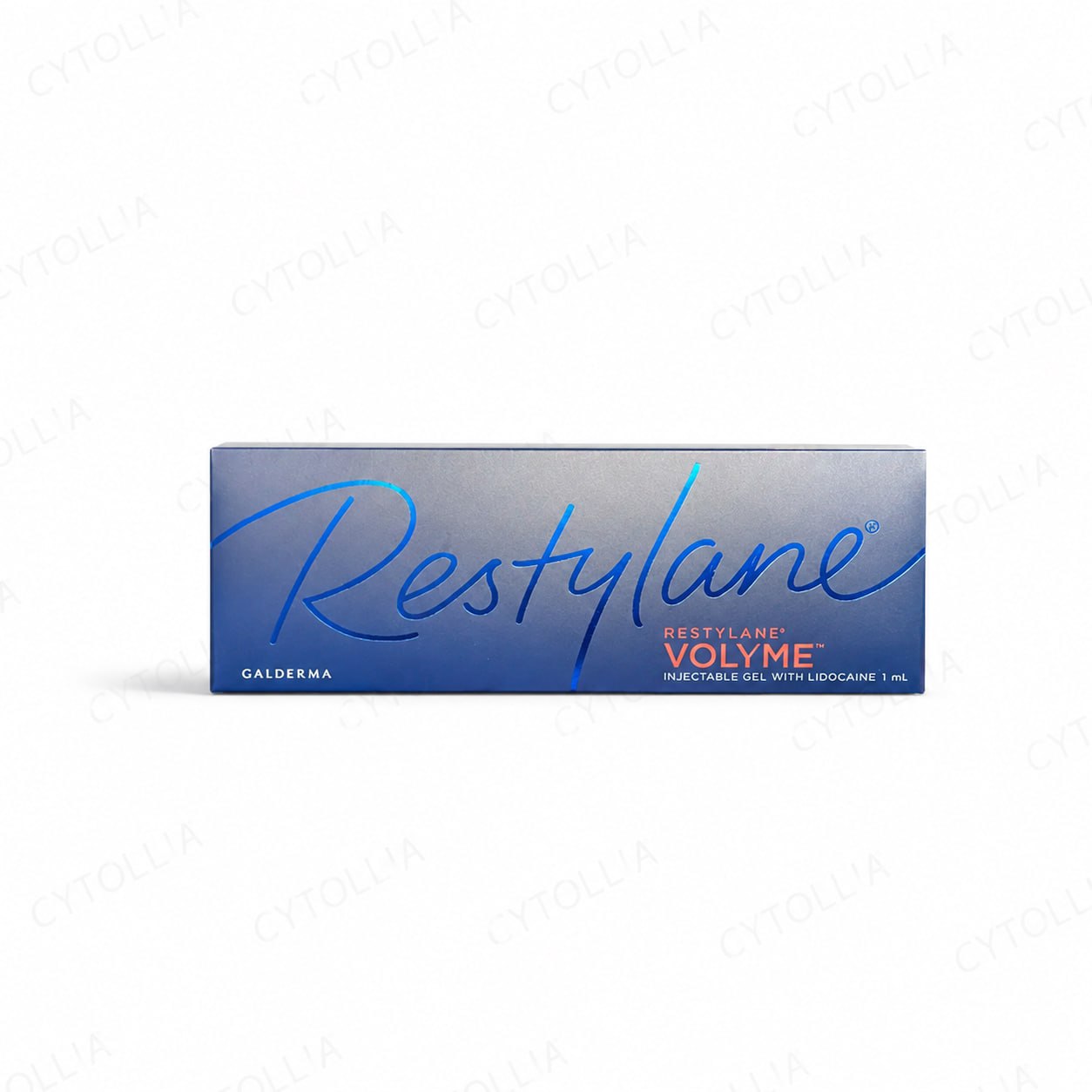
Restylane Volyme · OBT
The soft-volume conversation
The client language is fullness, softened transitions or a less angular contour. Volyme becomes relevant because its product story is built around moderately soft, flexible volumization—not because it is simply the “natural” option.
“Are you looking for more visible definition, or for softer fullness through the midface?” is a better opening question than “Which Restylane do you want?”
Cytollia Clinic Fit
When each SKU earns shelf space
Build around Lyft. The product has a clearer role when a meaningful share of consultations begins with structure, projection and shape rather than generalized fullness.
Build around Volyme. It is easier to position when clients are asking for cheek fullness and smoother facial transitions without making structural definition the headline.
Stock both. The pair makes commercial sense when the clinic already encounters both goals and the team can document two independent consultation and reorder patterns.
Choose one for now. If every request enters the same undifferentiated service, two Restylane SKUs add training and inventory without adding a new customer decision.
Treatment Menu Builder
Sell the design decision—not the technology acronym
The clinic does not need to publish NASHA and OBT as two technical services. It needs two promises that are easy to understand, easy to train and distinct enough to deserve separate product pathways.
Stocking Snapshot
Use the two-role test before carrying both
Buying the whole Restylane family can feel comprehensive, but a complete shelf is not the same as a complete menu. Before adding the second SKU, ask three commercial questions:
- Do both customer jobs already appear? Look for recurring demand for structure and recurring demand for softer fullness—not one request described with two sets of words.
- Can the team explain the difference in twenty seconds? If the answer requires a rheology lecture or ends with “this one is stronger,” the menu is not ready.
- Will each SKU generate its own reorder signal? Carry both when the clinic can track separate use and replenish each product for a distinct reason.
If only one role is established, begin with the product that fits the clinic’s existing service demand. Add the second when consultations—not the desire to display a complete range—show that the missing role is real.
Consultation Talking Points
Three ways to explain the difference without overselling it
“These products share the same headline HA concentration, but the gels are designed to behave differently.”
“The first decision is whether the plan needs more targeted structure or softer volume—not which box is stronger.”
“We select the product around the desired design and your anatomy rather than using one filler for every cheek request.”
That language gives the client a genuine choice without turning the consultation into a brand pitch. It also protects the value of each SKU: Lyft is not sold as the expensive or powerful option, and Volyme is not reduced to a softer substitute.
Published evidence
The most useful study tested the decision—not a winner
A 2024 multicentre study enrolled 60 women seeking cheek augmentation and assigned the product according to the primary treatment goal: the OBT product identified as Restylane Volyme/Contour for contouring, or Restylane Lyft for projection. Investigators assessed all participants as aesthetically improved at four and eight weeks, and the planned contouring or projection goal was achieved in both groups with high subject satisfaction.
That finding supports a product-selection framework: choose the gel around the job. It does not prove that either product is better overall, and the eight-week study was not designed as a long-term durability contest. One study author was affiliated with Galderma, which should be visible when the evidence is interpreted.
Both current instructions for use also identify injection-related reactions and rare but serious vascular complications. Individual product selection, suitability and technique belong with qualified professionals using the exact labeling for the supplied market.
Procurement decision
Before the next Restylane order
- Name the menu role first. Decide whether the next purchase supports structural definition, soft volume or two genuinely separate services.
- Train one clean explanation. Every team member should be able to describe the difference without using concentration as a ranking.
- Review the exact live listings. Confirm current product presentation, availability and tier pricing on Cytollia before the order is placed.
- Measure the second SKU. Track consultation uptake and reorder behaviour so the range grows from demand rather than assumption.
FAQ
Frequently asked questions
What is the main difference between Restylane Lyft and Volyme?
Lyft uses NASHA technology and is positioned around a very firm gel, targeted structure and projection. Volyme uses OBT technology and is positioned around moderately soft, flexible volumization and softer contour.
Do Lyft and Volyme contain the same HA concentration?
Yes. The current product information reviewed for both lists 20 mg/mL cross-linked HA and 3 mg/mL lidocaine. Their different clinic roles come from gel design and product properties, not a concentration ladder.
Is Restylane Volyme the same as Restylane Contour?
A 2024 publication describes Restylane Volyme as known as Restylane Contour in the United States. Market names, packaging and instructions can differ, so the exact supplied SKU and its current local labeling should remain the purchasing reference.
Which is firmer, Restylane Lyft or Volyme?
Galderma describes Lyft as very firm with high lifting capacity, while Volyme is described as moderately soft. That makes Lyft the clearer candidate for targeted structure and Volyme the clearer candidate for softer volume, subject to individual professional assessment.
Are Restylane Lyft and Volyme interchangeable?
They may enter some of the same broad midface conversations, but they should not be treated as automatic substitutes. Their strongest product stories solve different design jobs.
Does a clinic need to stock both products?
Only when the clinic regularly sells both structural-definition and soft-volume services. If the menu currently supports one clear job, one well-positioned SKU is usually easier to train, explain and reorder.
Does one product last longer?
The comparative study used here followed participants for eight weeks and was designed to evaluate goal-based product selection, not long-term superiority. Duration claims vary with the exact product, treatment area, individual and market labeling, so headline longevity should not replace the design decision.
Current Cytollia products
Choose the Restylane role that matches your clinic menu
Live product pages carry current availability and pricing. The article does not freeze either figure into editorial copy.
NASHA · TARGETED STRUCTUREView Restylane LyftProduct details and live pricing →
OBT · SOFT VOLUMEView Restylane VolymeProduct details and live pricing →
Wholesale requirements can be discussed after the clinic has identified the product role it needs.
Sources and editorial note
- Restylane Science & Technology: NASHA and XpresHAn/OBT
- Galderma Aesthetics: Finding the right filler for your treatment
- Restylane Lyft with Lidocaine Instructions for Use
- Restylane Volyme Instructions for Use
- Nikolis A, et al. Effectiveness of hyaluronic acid fillers for cheek augmentation using a treatment guide to choose between products. J Cosmet Dermatol. 2024.
Last verified: August 3, 2026. Cytollia sells both products discussed in this guide. Current price and availability are maintained on the product pages. This article explains product-selection and clinic-menu logic for aesthetic professionals; it is not individualized treatment advice and does not determine clinical superiority.
