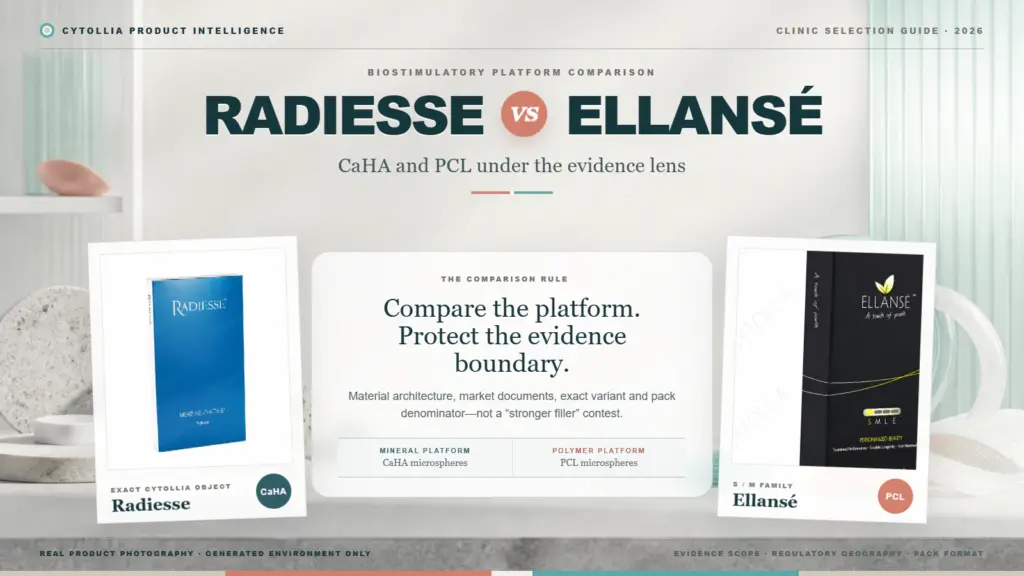
Clinic procurement intelligence
Radiesse vs Ellanse is a valid clinic comparison because both are prefilled microsphere-and-carrier platforms with an early physical phase and a later tissue-response phase. It is not an equivalence test. Radiesse uses calcium hydroxylapatite (CaHA) microspheres; Ellansé uses polycaprolactone (PCL) microspheres and adds an S/M duration architecture. The choice therefore starts with the exact product, governing market document, evidence level, variant commitment and pack denominator—not with a claim that one material is simply stronger.
This guide is written for medspa owners, clinic managers, medical directors, experienced injectors and procurement teams. It organizes the technical and commercial questions that determine whether Radiesse, Ellansé S, Ellansé M or neither belongs on a clinic shortlist. It does not select treatment for an individual and does not provide dose, dilution, device, injection plane, technique, anatomical instructions or aftercare.
Direct answer
Choose by platform fit and evidence fit—not by a universal winner
Radiesse enters the conversation when a clinic needs the exact CaHA brand object, a current U.S. FDA brand document for a U.S.-specific review, and one clearly identified 1.5 mL commercial SKU. Ellansé enters the conversation when the clinic deliberately wants a PCL platform with distinct S and M duration commitments and can preserve exact variant identity through consultation, ordering and records.
Neither should be the default when the requirement is an HA product with a hyaluronidase pathway, the intended use sits outside the applicable instructions, product-specific training is absent, or procurement requires a proven Radiesse-versus-Ellansé clinical winner. Current evidence does not establish that winner.
Professional education only. Product selection and use remain controlled by the current destination-market IFU, qualified clinical judgment, appropriate training, local law, patient-specific assessment and clinic governance.
Comparison logic
Why the Radiesse and Ellansé comparison is real—but not an equivalence
The real Radiesse vs Ellanse overlap is that both products combine particles with a carrier rather than behaving like a simple single-material gel. That shared architecture makes the business question meaningful: a clinic may be evaluating two ready-supplied biostimulatory platforms that each require product-specific explanation, traceability and long-term commitment. It also corrects a common oversimplification. Ellansé is not only “slow collagen,” and Radiesse is not only “instant filler.” Each has an early carrier-related physical role and a later material-associated tissue response.
The common category does not make the products interchangeable. CaHA and PCL have different chemical structures and degradation frameworks. Their exact formulations, supporting studies, market documents, variant systems and supplied packs are different. A volume printed on a carton is not a potency unit; a marketed duration horizon is not a universal outcome; and one product’s regulatory indication cannot be transferred to the other.
Comparable
Clinic platform questions
Carrier-plus-particle architecture, exact SKU identity, evidence maturity, destination-market documentation, supply traceability, training load, stock turnover and the service promise the team can explain accurately.
Not equivalent
Claims that need direct proof
Dose, potency, rheology, durability, clinical outcome, safety rank, anatomical role, reversibility, number of services and overall superiority. Material resemblance or a shared carrier cannot prove these fields.
Brand-level snapshot
Radiesse vs Ellansé at a glance
This Radiesse vs Ellanse table deliberately limits itself to product fields that can be traced to current documents or verified Cytollia objects. It is a shortlisting tool, not a treatment protocol.
| Decision field | Radiesse | Ellansé | Clinic meaning |
|---|---|---|---|
| Particulate platform | Synthetic CaHA microspheres | PCL microspheres | Mineral and polymer platforms require different evidence and product explanations. |
| Carrier in cited source | Sterile water, glycerin and sodium CMC gel in the cited U.S. FDA IFU | Phosphate-buffered saline, glycerin and CMC carrier in the cited SSCP | Both have an early carrier phase; similar carrier language does not establish equivalent behaviour. |
| Current Cytollia object | One verified 1.5 mL listing, product ID 778 | S or M, each verified as 2 × 1 mL, product IDs 633 and 636 | The cartons do not share a horizontal box-price denominator. |
| Variant architecture | The exact supplied Radiesse object must remain identifiable | S/M duration-coded PCL family | Ellansé requires the clinic to keep variant identity visible; M is not a “strength” grade. |
| Reversibility boundary | Not an HA/hyaluronidase pathway | Not an HA/hyaluronidase pathway | Product commitment, complication planning and informed consent cannot copy an HA service model. |
Material architecture
The technical difference that changes the clinic decision
In a Radiesse vs Ellanse technical review, a material name is useful only when it remains attached to the exact commercial object and source. The following descriptions explain why each platform may enter a shortlist; they do not assign an injection area or promise a clinical result.
Radiesse: CaHA microspheres in a cohesive gel carrier
The current FDA Radiesse product document describes a sterile, semisolid, cohesive implant containing synthetic calcium hydroxylapatite microspheres suspended in a gel carrier made with sterile water, glycerin and sodium carboxymethylcellulose. It identifies the 1.5 cc presentation and a 25–45 μm particle-size range.
For a technical review, this supports three defensible statements: the object is a prefilled CaHA-and-carrier platform; the carrier contributes an early physical phase; and the particles are the longer-lived material component associated with the tissue response. Its cited U.S. uses remain market-specific.
Ellansé: PCL microspheres with an S/M duration architecture
The cited Ellansé SSCP describes PCL microspheres in a carrier containing buffered solution, glycerin and CMC. The manufacturer’s technical guide explains S and M as members of the same platform whose PCL chain design supports different expected duration horizons.
That distinction must not become a strength ladder. M should not be described as more concentrated, more powerful or automatically intended for a different anatomical plane merely because its letter follows S. A clinic that carries both needs two accurately named service commitments and SKU records—not one generic “Ellansé” line.
The useful two-phase model is operational rather than promotional. Staff should be able to explain which part of each product provides the early physical presence and which material remains relevant to the later tissue response, without turning that explanation into a duration promise. For Radiesse, the distinguishing decision is a mineral CaHA microsphere platform in a prefilled gel. For Ellansé, it is a polymer PCL microsphere platform whose S/M architecture adds a second decision about duration commitment. That is a real technical difference; it is not proof that one product produces a stronger result.
Brand-to-material evidence firewall
What is direct, what is borrowed and what is not Radiesse
Many Radiesse vs Ellanse pages fail at the same translation step: a paper says “CaHA” and “PCL,” then the summary silently renames those materials Radiesse and Ellansé. That move is valid only if the methods identify those exact brands and the study population, use, endpoint and follow-up match the claim being made.
PCL versus CaHA in 30 female rats
Yanatma and colleagues compared PCL and CaHA groups with histologic assessment at two and four months. This can inform a material-level discussion about tissue response. It cannot establish human clinical superiority. The CaHA brand is not identified in the evidence table used for this review, so it also cannot be renamed Radiesse.
Ellansé versus Aphranel—not Radiesse
The 147-patient retrospective T-zone study used Ellansé for PCL and Aphranel for CaHA. It was single-centre, non-randomized, lacked a placebo or no-injection control, did not stratify dose, and adjusted techniques between materials. It is current comparative human evidence, but it is not a Radiesse-versus-Ellansé trial.
The practical rule is simple: if the brand is not in the methods, the brand cannot be the winner in the conclusion. A Radiesse clinical-evidence claim needs Radiesse-level evidence. A PCL-vs-CaHA mechanism statement should stay at material level unless exact-product evidence supports the next step.
Technical clinic-entry matrix
What kind of clinic condition puts which product on the shortlist?
This Radiesse vs Ellanse matrix is the core selection layer. It maps a clinic requirement to the platform that deserves further evaluation, then states what still needs confirmation. The first question is technical—mineral CaHA or polymer PCL, one commercial object or an S/M duration family—before inventory and documentation are considered. It does not convert a procurement condition into an individual treatment recommendation.
| Clinic condition | Candidate path | Technical reason | Still confirm | Do not conclude |
|---|---|---|---|---|
| The clinic wants a mineral CaHA platform with a carrier phase and a later particle-associated response | Radiesse enters | Radiesse combines CaHA microspheres with a prefilled cohesive gel carrier, creating one platform with two distinguishable phases. | Exact supplied object, clinical objective, demand and team readiness. | The two-phase architecture makes Radiesse universally stronger or suitable for every use. |
| The menu deliberately needs a shorter and a longer PCL commitment | Ellansé S/M enters | S and M provide a duration-coded architecture within the same PCL-and-CMC platform. | Exact variant, local documents, evidence horizon, demand, pricing logic and separate record keeping. | M is not a stronger, deeper or universally better form of S. |
| The clinic wants one clearly defined 1.5 mL CaHA inventory object | Radiesse can enter stock review | Cytollia currently identifies one 1.5 mL Radiesse object, simplifying the commercial object being evaluated. | Real demand, stock rotation, batch, expiry, storage, local document and training readiness. | One SKU does not mean clinically simpler, safer or suitable for more clients. |
| The clinic can genuinely separate two PCL services and preserve SKU identity | Ellansé S, M or both | The two variants can support different duration commitments when those commitments change the consultation and stocking plan. | Whether demand is distinct enough to prevent duplicate stock and whether every quote and record names S or M. | The S/M letters are not a treatment-area map or dose scale. |
| The priority is an HA product with a hyaluronidase pathway, or applicable evidence/training is absent | Neither by default | Neither platform is an HA filler, and neither should inherit an HA-equivalent reversibility promise. | The real clinical objective, applicable IFU, alternative product category and qualified professional assessment. | A clinic must choose one of these two simply because both are commercially available. |
| Procurement requires a proven brand-level clinical winner | Neither from current evidence | Current material studies and the 2026 Ellansé-versus-Aphranel cohort do not establish a universal Radiesse-vs-Ellansé winner. | Whether a new direct randomized brand-level study has appeared for the exact intended claim. | Evidence from another CaHA brand or an unnamed CaHA can be transferred to Radiesse. |
The technical answer is conditional, not vague: Radiesse is the clearer document-led CaHA path; Ellansé is the clearer variant-led PCL path; neither is the defensible path when the clinic requires HA reversibility, lacks the applicable documentation or training, or demands a brand winner that current evidence cannot provide.
Pack-denominator check
Why Radiesse 1.5 mL and Ellansé 2 × 1 mL are not a horizontal price comparison
Cytollia currently lists Radiesse as one 1.5 mL commercial object and Ellansé S and M as 2 × 1 mL objects. Those figures describe what is in the current listings; they do not declare equivalent dose, potency, service yield or clinical value. A Radiesse vs Ellanse cost discussion therefore needs the denominator named before any amount is compared.
No treatment count should be inferred from the carton. The same rule protects both products: a pack can support an inventory calculation only after qualified professionals establish the applicable, product-specific clinical plan outside this editorial.
Safety and professional-use boundary
Neither platform should inherit the operating assumptions of an HA filler
A safe Radiesse vs Ellanse comparison begins by recognizing that neither product is a hyaluronic-acid gel, and neither should be sold with an HA-equivalent hyaluronidase reversal promise. Product commitment, informed consent, practitioner qualification, anatomical knowledge and complication planning are central to both pathways.
Both require product-specific contraindication and warning review; unintended intravascular introduction can cause serious harm, but this article does not provide management instructions.
Before-you-stock checklist
Six questions a procurement team should be able to answer
Clinic FAQ
Frequently asked questions about Radiesse vs Ellansé
The Radiesse vs Ellanse questions below answer evidence and procurement boundaries; they do not choose an individual treatment.
Is Ellansé the same type of filler as Radiesse?
No. Both are microsphere-and-carrier biostimulatory platforms, which makes the comparison useful, but their particulate materials differ. Radiesse contains CaHA microspheres; Ellansé contains PCL microspheres and is offered in S/M duration variants. Shared category language does not make their formulation, evidence, market status or clinical use equivalent.
Does Radiesse or Ellansé stimulate more collagen?
Current evidence does not support a universal brand-level answer. Animal and material-level studies can compare tissue markers, but they do not automatically establish greater human collagen production for an exact commercial brand across indications. A defensible claim needs a direct, appropriately designed product-level study with relevant endpoints and follow-up.
Is there a direct Radiesse vs Ellansé clinical trial?
The evidence reviewed for this draft did not identify a direct exact-brand clinical trial that establishes a universal Radiesse-versus-Ellansé winner. A 2021 study was an animal PCL-vs-CaHA comparison with the CaHA brand not identified. A 2026 human cohort used Ellansé and Aphranel, not Radiesse.
Does the 2026 PCL-vs-CaHA study prove Radiesse is better?
No. Its CaHA product was Aphranel. The study was also retrospective, single-centre and non-randomized, with no placebo or no-injection control, limited dose stratification and technique differences between material groups. Its findings should remain attached to those exact methods and should not be relabelled as Radiesse evidence.
Which lasts longer, Radiesse or Ellansé?
A universal winner cannot be declared from product-family marketing horizons. Ellansé S and M are explicitly organized around different expected duration commitments, while Radiesse duration claims depend on the exact product, indication, study and market source. Compare applicable evidence and service commitment; do not promise one personal month count.
Is Ellansé M stronger than Ellansé S?
No reliable source reviewed here defines M as a stronger grade. Manufacturer technical material describes the distinction through longer PCL chain design and a longer expected duration horizon. The letter does not independently prove greater concentration, larger particles, different injection depth, a different treatment area or superior clinical performance.
Can Radiesse or Ellansé be dissolved with hyaluronidase?
Neither is an HA filler, so neither should be presented as having an HA-equivalent hyaluronidase reversal pathway. That statement is a planning boundary, not a complication-management tutorial. Qualified professionals must use the exact product safety information, appropriate training and an established adverse-event pathway.
How should a clinic compare the current Cytollia pack formats?
Start with exact commercial objects: Radiesse is currently listed as 1.5 mL, while Ellansé S and M are currently listed as 2 × 1 mL. Then compare current live price, applicable documents, demand, turnover and service model. Do not infer equivalent dose or treatments per box.
Procurement conclusion
Choose the documented platform—not the bigger number or longest headline
The final Radiesse vs Ellanse decision should be conditional. Put Radiesse on the shortlist when the exact CaHA object, applicable brand documentation and one clearly defined 1.5 mL inventory line fit the clinic’s requirement. Put Ellansé S, M or both on the shortlist when a PCL duration architecture serves a real menu need and the team can maintain exact variant, evidence and stock traceability.
Choose neither by default when the goal requires an HA reversibility model, the proposed use lacks applicable documentation or training, the two products would only duplicate existing inventory, or the buying decision requires brand-level superiority that current evidence does not establish. The defensible sequence is: identify the market and service requirement, select the material platform, confirm the exact product and variant, then validate the live commercial object.
Current Cytollia objects
Check the exact product, pack and live tier position
After the Radiesse vs Ellanse framework is resolved, these links lead to the commercial objects verified on August 20, 2026. Availability and tier prices can change, so this editorial does not freeze either field.
Primary sources and evidence notes
- U.S. FDA — RADIESSE Injectable Implant Instructions for Use, P050052S162D: exact U.S. product description, 1.5 cc presentation, particle range, carrier composition, indications, contraindications and warnings.
- Ellansé Summary of Safety and Clinical Performance: PCL-microsphere/CMC-carrier device family, variants, safety and clinical evidence summary.
- ELLANSÉ — An Expert’s Guide: manufacturer technical explanation of PCL architecture and S/M duration design; not used alone for superiority.
- Yanatma et al., 2021: PCL-versus-CaHA comparison in 30 female rats at two and four months; animal and material-level evidence, with no Radiesse brand conclusion.
- Gao and Wang, 2026: retrospective, single-centre 147-patient cohort using Ellansé and Aphranel; not a Radiesse comparison.
- Haddad et al., DeVries et al., and the CaHA/PCL systematic review: material-level context and evidence-landscape review, not exact-brand winner evidence.
Sources, public Cytollia objects and internal links were checked on August 20, 2026. Product documents, registrations, safety notices, packaging and availability can change. Refresh every time-sensitive field before publication and again before procurement.
