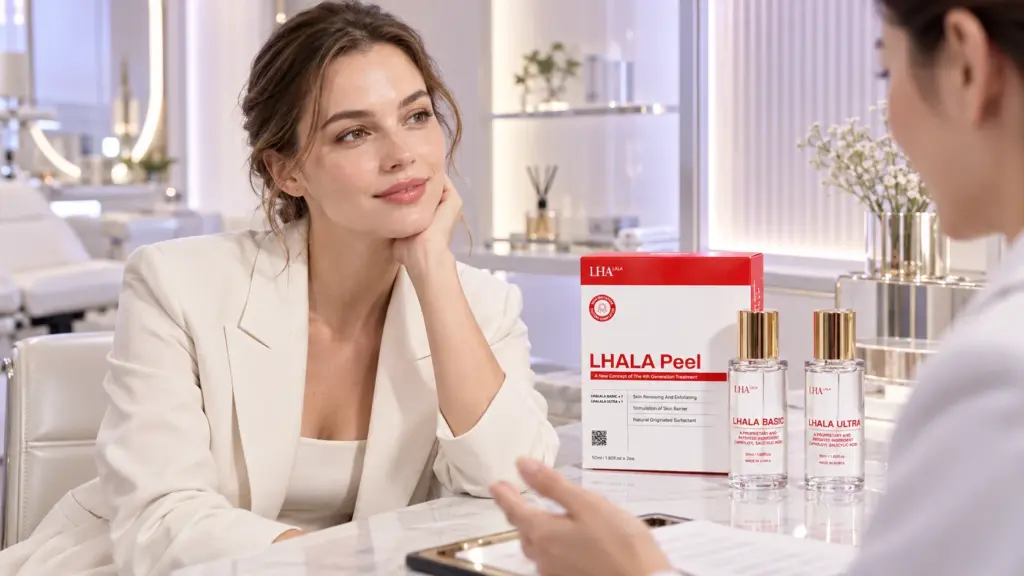
No client walks into a clinic asking for a “fourth-generation peel.” She asks why foundation keeps catching around her nose, why her skin still looks flat after a good routine, or whether she can get a fresher finish without spending the following week hiding visible flakes. That gap between technical language and the result a client can picture is exactly where Lhala Peel earns its place.
For a clinic, the appeal is simple to communicate. Lhala Peel gives dull, uneven or congested-looking skin a professional renewal story centred on polish rather than drama. The service can be introduced through the changes clients already look for in the mirror: a smoother surface, clearer-looking tone, softer-looking pores and the kind of fresh sheen that makes makeup sit better.
Start with the mirror problem
The problem is not “dead skin”—it is what the client sees in the mirror
Peel menus often start with acid percentages, generations or ingredient names. Clients usually start somewhere else. They notice that light catches unevenly across the cheeks, that the area around the nose looks textured, or that a careful skincare routine has not produced the polished finish they expected.
Those small frustrations create a strong service category because they are visible every day. They show up under foundation, in phone-camera light and in the contrast between a hydrated cheek and a congested T-zone. A client may describe the problem as “dull,” “bumpy,” “clogged” or simply “tired.” She does not need a chemistry lesson before she can recognise the goal.
Lhala Peel fits this conversation because its story is surface renewal with a comfortable-looking finish. The manufacturer positions the system around exfoliation, skin rebalance, texture, sebum and pigmentation concerns, while its Basic and Ultra formats have each returned a non-irritant result in separate irritation tests involving 30 volunteers per format.
That makes the strongest consultation language visual and specific:
| What the client says | What she wants to notice | The clinic’s Lhala Peel story |
|---|---|---|
| “My skin looks dull even when it is moisturised.” | More light reflection and a fresher-looking tone | Lift the rough surface that makes healthy skin look flat |
| “Foundation catches around my nose and cheeks.” | A smoother canvas with less obvious texture | Refine the surface without selling an aggressive-resurfacing experience |
| “My pores always look dirty.” | Cleaner-looking congestion and a more polished T-zone | Use an LHA-led renewal story for oily, pore-prone areas |
| “I want a peel, but I have work and plans.” | A presentable, low-disruption finish | Position the service around polish and comfort rather than visible shedding |
The ingredient logic
Why LHA gives the peel a different feel
LHA—capryloyl salicylic acid—is a lipophilic derivative of salicylic acid. Its affinity for oil helps explain why it belongs naturally in conversations about uneven texture and comedonal congestion. Research on this ingredient family describes a slower, more surface-focused pattern of exfoliation than conventional salicylic acid, with corneocytes released more individually rather than in broad sheets.
The science matters because it connects directly to the client experience. In human-skin research, a cream containing a lipophilic salicylic-acid derivative improved smoothness, firmness and clarity while increasing markers associated with epidermal renewal. A separate randomized split-face study in 20 people with comedonal acne found a significant reduction in non-inflammatory lesions on the LHA-treated side, with the peels generally well tolerated.
Those studies are not trials of the finished Lhala Peel set, and they do not need to be stretched into one. Their practical value is that they support a credible ingredient story: LHA is relevant when the clinic wants to talk about smoother texture, clearer-looking congestion and renewal without making “stronger” the headline.
Lhala adds its own formulation story around that ingredient. The current product information pairs LHA with INCUBE 504, H2sol and a lipid complex, giving the clinic language for a peel designed around renewal and skin comfort rather than inflammation-led resurfacing.
The visible result
What clients actually notice after Lhala Peel
The search for “Lhala Peel before and after” is rarely a request for a microscope view. It is a request to know whether the appointment will make a visible difference. The most persuasive outcome is often subtle enough to look believable and immediate enough to feel rewarding.
The surface looks more polished
When rough corneocytes stop scattering light in different directions, the complexion can look smoother and more even. Clients may describe this as glow, but the visible change is usually better reflection across the cheek, forehead and nose rather than a glossy coating on top of the skin.
Makeup has a better canvas
A client who notices foundation catching around pores or dry texture has an easy way to judge the result. A refined surface can make base makeup look less patchy and help the face appear fresher even before colour products are added.
Congestion looks less dominant
LHA’s oil affinity makes it a sensible ingredient story for clients who are bothered by closed comedones, blackhead-prone areas or a T-zone that never looks fully clean. The promise should stay visual and realistic: clearer-looking pores and a more even surface, not permanently erased pores.
The finish feels cared for, not stripped
The treatment becomes more distinctive when the renewed surface is followed by a moisture-rich, calming finish. That is why the Lhala Peel Gel Mask belongs in the commercial story. It turns the final impression into cool comfort and bounce, rather than allowing “peel” to sound synonymous with tightness.
Choose by client concern
Lhala Peel vs Aqua Peel: they solve different mirror problems
“Lhala Peel vs Aqua Peel” appears in current search suggestions because both services are associated with clearer-looking, more polished skin. The useful answer is not that one is universally better. It is that they begin with different customer complaints.
| Decision point | Lhala Peel | Aqua Peel |
|---|---|---|
| The client leads with | Dullness, rough texture, uneven surface and a wish for glow | Blackheads, oily congestion and a wish to see pores physically cleansed |
| The service story | LHA-led exfoliation and surface renewal | Solution flow plus suction-led pore cleansing |
| The result she is watching for | Smoother light reflection, refined texture and a fresh finish | A cleaner-feeling T-zone and visibly cleared debris |
| The clearest menu position | Korean glow and texture-renewal peel | Deep-cleansing or pore-clearing facial |
A congestion-led clinic can carry both without creating duplication. Aqua Peel can own the “clean it out” conversation, while Lhala Peel owns the “smooth and brighten the surface” conversation. If the clinic only wants one new service, the choice should follow the question its clients already ask most often.
Build the complete Lhala route
Sell the finish first, then show the system
Once the client understands the result, the complete Lhala route becomes commercially useful rather than looking like a list of accessories. Each product supports a recognisable part of the service experience.
The Lhala Peel Basic + Ultra set is the core professional treatment. The Lhala Peel Cleanser Foam gives the service a consistent, neutral-pH preparation step without turning the consultation into a protocol lesson. The Lhala Peel Brush makes the product family visually complete and keeps the professional application tool attached to the same buying route. The Lhala Peel Gel Mask carries the service through to the cool, hydrated finish clients remember.
For a buyer, this creates more than a hero product. It creates a coherent menu ritual that can be photographed, named and explained consistently by every member of the clinic team. It also gives retail and treatment-page content a natural visual sequence without publishing application instructions or reducing the service to carton specifications.
THE CORE SERVICE
Lhala Peel Basic + Ultra
The professional LHA peel at the centre of the menu story
View the peel →
THE CLEAN START
Lhala Peel Cleanser Foam
A neutral-pH cleansing route for the complete professional line
View the cleanser →
THE FINISH CLIENTS FEEL
Lhala Peel Gel Mask
A moisture-rich finish that completes the glow-and-comfort story
View the mask →
THE PROFESSIONAL DETAIL
Lhala Peel Brush
The matching applicator for a consistent, recognisable service setup
View the brush →
What people ask before booking or buying
The questions clients and clinic buyers ask
Does Lhala Peel make the skin visibly peel?
Lhala Peel is positioned around a low-flaking, low-disruption experience rather than a dramatic shedding phase. The exact response depends on the client’s skin and professional assessment, but the menu story is polished-looking renewal—not a week of obvious peeling.
Is Lhala Peel better than Aqua Peel?
They answer different priorities. Choose the Lhala story when the client leads with dullness, rough surface texture and glow. Choose the Aqua Peel story when she leads with blackheads, oily congestion and suction-based pore cleansing.
Is Lhala Peel a professional treatment?
Yes. The current manufacturer information identifies it as an in-office product for professional external use. Clinics should use the current product documentation and their local professional requirements when deciding suitability.
Where can a clinic buy the complete Lhala Peel line?
Cytollia currently lists the Lhala Peel treatment set, Cleanser Foam, Gel Mask and professional brush as separate purchasing routes, so a buyer can build the line around the parts the clinic intends to offer.
The commercial takeaway
A peel becomes valuable when the client can picture the result
Lhala Peel keeps appearing on Korean clinic menus because it gives a familiar request—brighter, smoother, fresher-looking skin—a service identity of its own. The strongest message is not the generation number on the box. It is the moment a client sees that her skin catches light more evenly, her makeup has a better canvas and a peel no longer has to mean putting life on hold.
For a clinic buyer, that is a useful product story. It is easy for staff to explain, different from a suction facial, and complete enough to build into a named treatment rather than a generic add-on. Start with the result clients already ask for, then let the Lhala system support the experience from preparation to finish.
Evidence and disclosure
Sources and editorial disclosure
- LHALALA U.S. — LHALA Peel product and technology information
- Mechanism of action of a lipophilic derivative of salicylic acid on normal skin
- Randomized trial comparing a lipophilic hydroxy acid derivative of salicylic acid with a salicylic acid peel in subjects with comedonal acne
- The use of hydroxy acids on the skin: characteristics of C8-lipohydroxy acid
Independent studies cited here support the LHA ingredient category and its relevance to surface renewal and comedonal congestion; manufacturer information supports the current Lhala Peel positioning and product identity. Cytollia links are commercial product routes. Outcomes vary, and professional suitability should follow current product documentation and applicable local requirements.
