
The result of a Curenex Snow Peel is better read as a week-long progression than an instant reveal. On the day of treatment, the skin is at the start of the process; around days three to five, the surface may feel drier or slightly rough as it renews; by day seven, the useful questions are whether the complexion looks clearer, the texture feels smoother, pores and congestion look less dominant, and the skin has recovered some spring.
That makes Curenex Snow Peel especially easy to position for clients whose skin looks dull, uneven or congested and who want a visible skin-quality change rather than added facial volume. The best scorecard is not how dramatically the skin flakes. It is how the face looks under the same light one week later.
Day 1 begins the process. Day 7 shows the finish.
Track clarity, texture, pore visibility and firmness—not just whether the client visibly peels.
Read the week in stages
The Snow Peel result comes in three chapters
Snow Peel is easier to explain when day one is not presented as the final result. The manufacturer’s published timeline gives clinics a simple three-part story: early activation, a short renewal window, then the first meaningful evaluation point.
THE TREATMENT DAY
Skin feels activated before it looks finished
A prickly sensation, temporary redness or more visible pores can occur. These are early treatment responses, not the result a client should judge in the mirror.
THE RENEWAL WINDOW
The surface can feel different before it looks polished
Mild flaking, dryness, tightness or a rougher feel can appear as the outer surface turns over. Some clients notice very little visible shedding; others see more.
THE RESULT CHECKPOINT
Clarity, texture and bounce become easier to compare
This is the point to look for brighter light reflection, a smoother-looking surface, more refined texture and a firmer, fresher overall impression.
The timing matters because a client who studies her skin too closely on day two can mistake an unfinished phase for the outcome. A clinic that sets the seven-day checkpoint in advance gives the treatment time to tell the story it was designed to tell.
Make the result measurable
At day seven, look for four changes—not one vague “glow”
“Glow” is useful shorthand, but it is too broad to make a before-and-after convincing. A stronger evaluation separates the result into visible details that can be photographed and described.
1. Light should travel more evenly across the face
Dull skin often looks flat because rough, uneven areas scatter light. When the surface looks more orderly, the cheeks, forehead and bridge of the nose can reflect light with fewer broken patches. The result reads as clarity rather than artificial shine.
Use the same room, camera distance and angle for the day-zero and day-seven photos. If the lighting changes, a brighter image can be mistaken for brighter skin.
2. Texture should look calmer at conversation distance
The target is not an airbrushed close-up. It is a face that looks smoother when another person is standing in front of it: fewer rough-looking transitions, a more even makeup canvas and less visual interruption across the cheeks and T-zone.
For clients who first complained that foundation caught around the nose or that skincare never made the surface look polished, this is often the change that feels most relevant.
3. Pores and congestion should become less visually dominant
Curenex positions Snow Peel for enlarged-looking pores and congestion as well as rough texture. A useful result photo does not promise to erase pore anatomy. It asks whether the T-zone looks cleaner, whether shadowing around pores is softer and whether the overall surface appears more uniform.
4. The skin should regain a fresher sense of spring
Firmness is not the same as filler volume. Here, it means the skin looks less tired and the surface has a more resilient, cared-for finish. The manufacturer includes loss of elasticity among the concerns suited to Snow Peel, while PDRN, peptides and hydrating ingredients form part of the product’s conditioning story.
- Same lighting and camera distance
- Front, left three-quarter and right three-quarter views
- One makeup-free close-up of the cheek and T-zone
- Notes on texture, clarity, pores and firmness
Why the mirror needs time
What is happening while the mirror catches up
Curenex Snow Peel combines a purified micro-spicule component with a PDRN and multi-active conditioning component. The brand’s logic is twofold: refine accumulated surface cells while keeping the renewal story connected to hydration, brightness and skin quality.
The delayed timeline is also consistent with what is known about marine sponge spicules as a category. In a 2017 animal and laboratory study—not a clinical trial of the finished Curenex product—researchers found that sponge spicules could physically disrupt the skin and remain for at least 72 hours, allowing sustained delivery of model hydrophilic molecules.
That category evidence helps explain why a spicule peel is not best judged the moment the appointment ends. It does not prove that every Curenex client will follow an identical clock, and it does not turn an ingredient mechanism into a guaranteed outcome. The practical takeaway is simpler: the mirror may need several days to catch up with the treatment day.
A better way to judge progress
Judge the finish, not the flakes
One of the most common questions around spicule peels is whether a person must visibly peel for the treatment to have “worked.” The more useful answer is that visible shedding is a response, not the result itself.
The manufacturer’s timeline says mild flaking or dryness can appear around days three to five, while also noting that reactions vary from person to person. A client who sees little flaking can still compare clarity, texture, pore visibility and firmness at day seven. A client who does flake should not use the intensity of that phase as proof of a better result.
This distinction improves the consultation. It moves the conversation away from “How much skin came off?” and toward “Does the skin look clearer, smoother and more even now?” Those are the changes the client wanted in the first place.
Match the concern to the result
Who fits this seven-day result story best
Snow Peel has the clearest value when the concern lives at the level of skin quality. It suits a client who describes her complexion as dull, rough, congested or uneven; notices pores before she notices wrinkles; or feels that the skin has lost some freshness and spring.
The strongest matches are easy to recognise:
- Dull or uneven-looking tone: the goal is clearer, more consistent light reflection.
- Rough surface texture: the goal is a smoother-looking and smoother-feeling finish.
- Visible pores and congestion: the goal is a cleaner, more refined appearance rather than a promise of pore removal.
- Tired-looking skin with less bounce: the goal is renewed skin quality, not facial reshaping.
- Clients who want a result they can assess within a week: the timeline gives the clinic a defined follow-up point instead of an open-ended promise.
This is not a substitute for professional assessment. A clinic still needs to decide whether a peel is appropriate for the client’s current skin condition and to use the latest product documentation. That limitation can remain brief because the commercial message is already clear: Snow Peel is for improving how the skin surface looks, not changing facial structure.
Protect the comparison
The clinic should protect the comparison as carefully as the skin
The first week needs uncomplicated expectation-setting. The official Curenex information advises avoiding excessive heat and strenuous exercise for the first 24 hours and using sunscreen daily. Beyond those compact points, the most valuable thing a clinic can do is tell the client when to look again.
Book or request the follow-up image for day seven. Ask the client not to judge the result by a single bathroom-mirror moment, and record the same four markers each time: clarity, texture, pore/congestion appearance and firmness. A consistent comparison does more for trust than a dramatic promise.
For a clinic buyer, this also creates better marketing material. A seven-day photo pair with matching light tells a cleaner story than an immediate post-treatment image. It shows the finish the service is meant to deliver, rather than temporary treatment-day colour.
The product decision
Make Curenex Snow Peel the week-long skin-quality story on the menu
A peel earns a distinctive place when clients can understand what they are waiting for. Curenex Snow Peel does not need to be sold through vial counts or a dense ingredient lecture. Its strongest story is a visible progression: activation, renewal and a day-seven finish that can be judged through clarity, smoother texture, softer-looking pores and renewed spring.
Clinics can review the current Curenex Snow Peel product page or browse Cytollia’s wider professional Peeling collection. For buyers comparing a different menu position, Cytollia’s guide to why Lhala Peel keeps appearing on Korean clinic menus covers an LHA-led, low-disruption surface-polish story; this Curenex guide remains focused on the spicule peel’s seven-day result window.
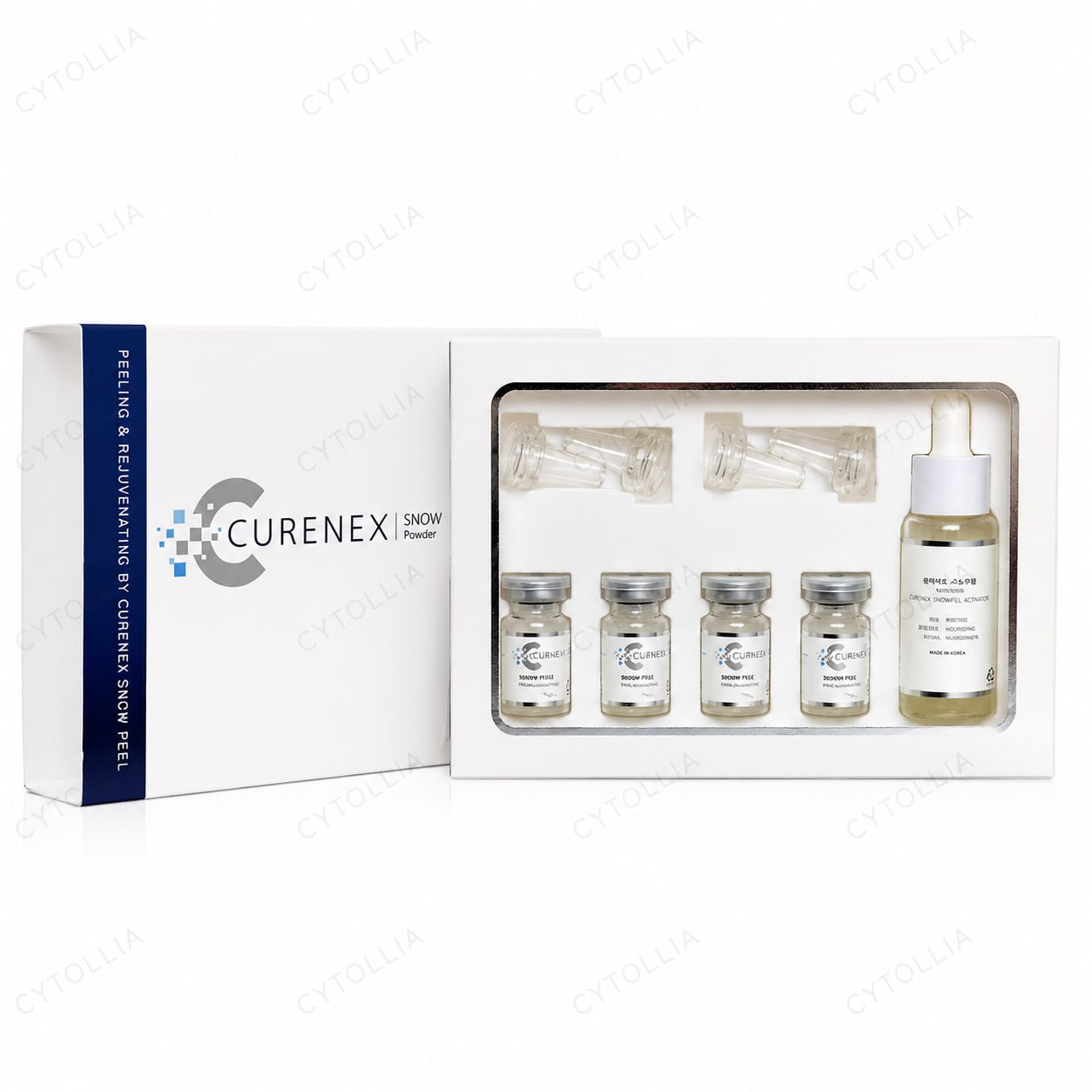
Curenex Snow Peel
A professional spicule and PDRN skin-renewal system for dullness, rough texture, visible pores, congestion and uneven-looking tone.
Evidence and disclosure
Sources and editorial disclosure
- Curenex Korea — official Curenex SnowPeel product information
- Curenex Japan — official professional-treatment information and seven-day timeline
- Curenex Japan — official Snow Peel landing page
- Zhang et al. — Skin Delivery of Hydrophilic Biomacromolecules Using Marine Sponge Spicules
Manufacturer sources support the finished product’s intended use, result language and published timeline. The independent paper supports the broader marine-sponge-spicule mechanism in animal and laboratory research; it is not a clinical trial of finished Curenex Snow Peel. Cytollia links are commercial product routes. Individual responses vary, and professional suitability should follow current product documentation and applicable local requirements.
