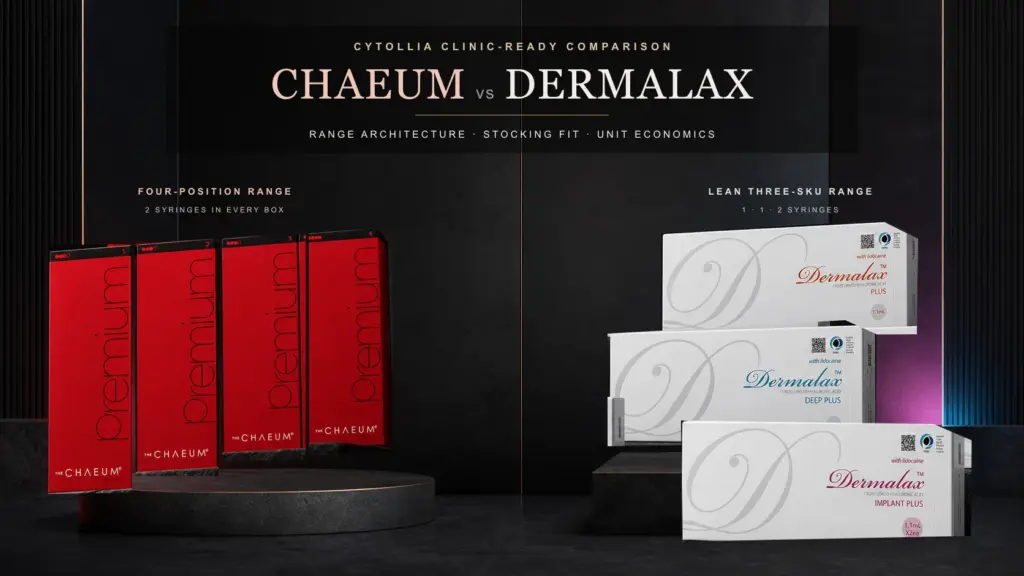
Chaeum vs Dermalax is usually presented as a brand question. For a clinic, it is more useful as a portfolio question. Both ranges sit in Across’s HA filler portfolio, yet they create very different decisions for training, menu design and inventory. Chaeum Premium asks the clinic to choose among four positions and supplies two 1.1 mL syringes in every box. Dermalax compresses the range into three SKUs, with one syringe in Plus and Deep Plus and two in Implant Plus.
Quick Answer
Chaeum offers more menu granularity; Dermalax offers a leaner entry
Chaeum Premium is the broader four-position range, while Dermalax is the leaner three-SKU range. In the manufacturer data reviewed, Chaeum spans four reported G′ positions and uses two-syringe boxes throughout. Dermalax spans three positions and lets a clinic enter its Plus or Deep Plus role with one syringe. Chaeum suits recurring demand across more product roles; Dermalax can reduce the volume committed when testing a smaller menu.
This comparison does not determine clinical superiority. It compares documented product architecture and current purchasing implications.
The real difference: four menu positions versus three stock roles
The tempting answer is that one line is “stronger” or “better.” The useful answer is that the two ranges solve the portfolio problem differently.
Chaeum Premium
More separation between roles
Four numbered products create a longer documented elasticity ladder. That can help a clinic build a more granular product menu, but every selected role starts with a two-syringe box.
Dermalax
A smaller core range
Three named SKUs simplify the shelf. Plus and Deep Plus use one-syringe boxes, while Implant Plus becomes the two-syringe structural end of the range.
This is not a cosmetic distinction. It changes how many roles staff must learn, how much product enters inventory with each decision and whether the clinic is more exposed to unused syringes or to gaps in its menu.
Why Chaeum and Dermalax belong in the same comparison
Across presents both product families in its HA filler portfolio. Its English overview describes The Chaeum as a domestic brand and Dermalax as a brand for export. That is useful context: these are not unrelated products pulled into a comparison because they happen to come from Korea. They are two portfolio structures published by the same company.
The shared source also makes the differences more interesting. Both current Plus lines contain lidocaine, use 1.1 mL syringes and move through larger supplied-needle diameters as the range progresses. Yet Across chose four numbered positions for Chaeum Premium and three named positions for Dermalax, then gave the two ranges different pack economics.
Range architecture at a glance
The manufacturer-branded technical brochure reports a four-step G′ sequence for Chaeum Premium and a three-step sequence for Dermalax. G′ describes one aspect of gel elasticity under a defined test, not the complete behaviour of a filler. Here it is useful as an internal map because the values were published together; it is not evidence that numeric neighbours are clinically interchangeable.
| Range decision | Chaeum Premium | Dermalax |
|---|---|---|
| Number of current positions compared | 4: No.1, No.2, No.3, No.4 | 3: Plus, Deep Plus, Implant Plus |
| Manufacturer-reported G′ ladder | 80 / 180 / 300 / 400 Pa | 80 / 160 / 280 Pa |
| HA concentration pattern | 24 / 20 / 20 / 20 mg/mL | 20 / 24 / 24 mg/mL |
| Supplied needle progression | 30G / 27G / 25G / 23G | 30G / 27G / 25G |
| Syringes per box | 2 / 2 / 2 / 2 | 1 / 1 / 2 |
| One box of every position | 4 boxes, 8 syringes, 8.8 mL | 3 boxes, 4 syringes, 4.4 mL |
The concentration pattern is the first reason not to use HA concentration as a strength ranking. Chaeum No.1 has the highest concentration in its compared line but the lowest reported G′. Dermalax Deep Plus and Implant Plus share 24 mg/mL but occupy different reported G′ positions. Product architecture, not one headline number, must do the decision-making work.
The closest numeric neighbours are not substitutes
A clinic comparing the ranges will naturally look for pairs. The published numbers reveal three close neighbours and one unmatched Chaeum position:
Chaeum No.1 and Dermalax Plus are both reported at 80 Pa and supplied with 30G needles. They differ in HA concentration—24 versus 20 mg/mL—and in two versus one syringe per box.
Chaeum No.2 and Dermalax Deep Plus sit at 180 and 160 Pa and both list 27G needles. Chaeum uses 20 mg/mL and two syringes; Dermalax uses 24 mg/mL and one.
Chaeum No.3 and Dermalax Implant Plus sit at 300 and 280 Pa, both with 25G needles and two-syringe boxes. Their listed HA concentrations remain different at 20 and 24 mg/mL.
Chaeum No.4 has no fourth Dermalax position in this comparison. It extends the reported Chaeum ladder to 400 Pa and a supplied 23G needle.
The point is not to create a substitution chart. Rheology can change with test conditions, and G′ does not capture every relevant product property. The useful conclusion is narrower: Chaeum provides one more documented step, while Dermalax covers a similar broad progression with fewer stock positions.
Clinic Fit Map: when each range makes more sense
Chaeum may fit better when…
- the clinic already has recurring demand across four distinct product roles;
- staff will benefit from a visible No.1-to-No.4 training ladder;
- two syringes per selected role are likely to turn over within the clinic’s normal purchasing cycle;
- the clinic values lower current unit cost more than the lowest possible box-entry cost;
- the additional fourth position fills a real service-menu gap rather than merely making the shelf look complete.
Dermalax may fit better when…
- the clinic wants a compact Detail / Core / Structure product story;
- Plus or Deep Plus will be tested with a one-syringe starting quantity;
- a lower total cash commitment matters more than the lowest current per-syringe price;
- separate product pages and SKUs make role-by-role ordering easier for the purchasing team;
- three clearly separated stock roles are sufficient for the existing treatment menu.
Neither range earns the word “better” without a clinic context. Chaeum wins on breadth in this comparison. Dermalax wins on the ability to enter two of its roles with a single syringe. Which advantage matters depends on demand, staff training and expected utilization.
Stocking Snapshot: lower entry cost is not the same as lower unit cost
Cytollia’s public catalogue prices were checked on July 31, 2026. At that snapshot, every Chaeum Premium variant was $49.40 per two-syringe box. Dermalax Plus and Deep Plus were $34.40 per one-syringe box, and Implant Plus was $68.80 per two-syringe box.
| Complete-shelf snapshot | Chaeum Premium | Dermalax |
|---|---|---|
| Boxes | 4 | 3 |
| Total syringes | 8 | 4 |
| Nominal product volume | 8.8 mL | 4.4 mL |
| Snapshot box total | $197.60 | $137.60 |
| Snapshot price per syringe | $24.70 | $34.40 |
Dermalax required less total cash for one box of every current SKU because the complete shelf contained half as many syringes. Chaeum cost less per syringe at the same snapshot. Both statements are true, and they answer different buying questions.
Prices exclude shipping, tax and any applicable tier pricing, and they may change. Check the live product pages before ordering.
How to choose without stocking every SKU
A range should be built around repeatable services, not completed like a collector’s set.
- Testing one new role: Dermalax Plus or Deep Plus creates a one-syringe entry point. Chaeum commits two syringes whenever a new number is added, so the expected turnover should justify that quantity.
- Building a broad recurring menu: Chaeum’s four positions can make training and role separation more granular. The model works best when each position has a defined reason to exist in the menu.
- Keeping the shelf deliberately lean: Dermalax lets a clinic start with the central product role and add either the lighter or structural end when demand appears. A complete three-SKU shelf is optional, not the default.
The same principle applies to both lines: if staff cannot explain why a position exists and purchasing cannot forecast its use, that SKU does not yet have a strong clinic role.
Consultation Talking Points
Patients do not need a catalogue lecture. Staff can explain the professional decision without turning product selection into a consumer ranking:
“We choose from a product range according to the treatment goal and professional assessment. A higher number or concentration is not automatically better; it represents a different position within that range.”
For the clinic team, the companion message is equally simple: menu breadth should follow service demand, while box quantity should follow expected utilization.
What this comparison does not conclude
The tables do not establish that products with similar G′ values behave identically, produce equal outcomes or can be substituted for one another. They also do not compare patient safety or clinical superiority. Product selection remains a professional decision based on the supplied product information, local authorization, patient assessment and the complete properties of the exact product.
Frequently Asked Questions
Are Chaeum and Dermalax made by the same company?
Across lists both families in its HA filler portfolio and publishes their current specifications. Its English overview describes The Chaeum as a domestic brand and Dermalax as an export brand. That shared company relationship does not mean the individual products are identical.
Is Chaeum better than Dermalax?
Not universally. Chaeum offers four compared positions and lower current per-syringe pricing on Cytollia, but every variant uses a two-syringe box. Dermalax offers three positions and a lower one-box entry for Plus and Deep Plus. The better fit depends on menu breadth and expected utilization.
Is Chaeum No.1 the same as Dermalax Plus?
No. The reviewed brochure reports both at 80 Pa G′ and both are supplied with 30G needles, but Chaeum No.1 lists 24 mg/mL HA and two syringes, while Dermalax Plus lists 20 mg/mL and one syringe. A shared G′ value alone does not establish equivalence.
Which range is cheaper for a clinic to stock?
At the July 31, 2026 snapshot, one box of every Dermalax SKU cost less in total: $137.60 versus $197.60 for all four Chaeum variants. The quantities were different—four Dermalax syringes versus eight Chaeum syringes—so Chaeum had the lower current price per syringe.
Does a clinic need every Chaeum or Dermalax variant?
No. Stock the positions that support repeatable services and expected demand. A complete line can be useful for a broad menu, but carrying every SKU without a defined role increases training and inventory pressure without automatically improving the clinic’s offer.
Current Cytollia Catalogue
Compare products and live unit pricing
Review current availability, product details and tier pricing before building your range.
