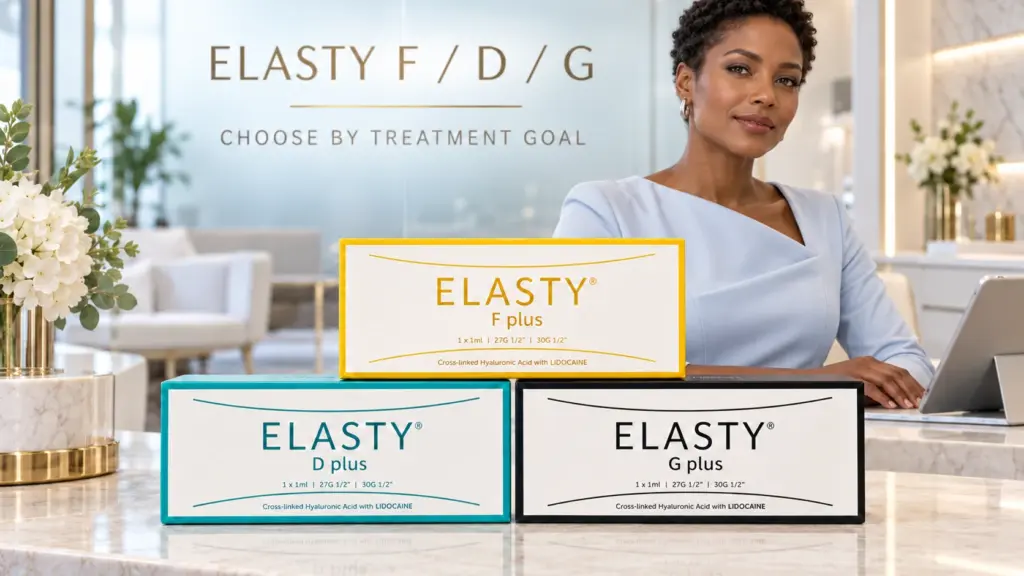
People rarely ask for a filler by its physical properties. They ask for lips that look softly defined, folds that no longer pull attention, or a chin and cheek line that reads more clearly in profile. The Elasty filler range makes more sense when it is read in that language: F for light refinement, D for balanced support and G for stronger definition.
The most natural-looking choice is not automatically the softest product in the range. It is the one whose behaviour suits the visual job. A delicate transition needs a different kind of support from a contour that should remain crisp, and a deeper fold asks for something different again.
Refine the detail
For a softer finish around fine lines, delicate transitions and subtly shaped lips.
Restore balance
For folds and facial volume that need more support without a strongly sculpted look.
Hold the shape
For cheeks, chin and jawline goals where projection and a clearer contour are the point.
The decision that comes before product selection
Begin with the finish, not the letter on the box
F, D and G are often presented as a ladder from softer to firmer. That is useful, but it still leaves the most important question unanswered: what should the face look like when the work is finished?
A soft result lets one area flow into the next without an obvious edge. A supported result restores shape or eases a fold while keeping the face relaxed. A defined result makes a feature more legible, especially from the side or three-quarter view. All three can look natural. They simply express naturalness in different ways.
This is also why choosing an Elasty filler by treatment-area name alone can be too blunt. Two clients may both ask about the lips, yet one wants only a smoother border while the other wants more body. Two clients may both ask about the chin, yet one wants a small balancing change and the other wants a noticeably clearer profile. The visible brief comes first; the product letter follows.
Soft transition
When the best result is quiet refinement
Within the Elasty filler family, F is the lightest, most refinement-led option. Its role is not to announce that volume has been added. Its role is to make a detail feel more polished: a fine line that catches makeup, a lip edge that could look smoother, or a delicate area where the finish should blend quietly into the surrounding tissue.
For clinics, F gives a clear answer to the client who says, “I want to look fresher, but I do not want a feature to look built.” The result to discuss is subtle smoothing and gentle definition rather than projection. That is especially useful when the desired change should be noticeable mainly as a better overall finish.
Calling F the softer option should not make it sound like the lesser option. Softness is the performance goal. When the job is refinement, a product that integrates discreetly can create a more convincing result than one chosen for stronger shape retention.
Balanced support
When the face needs support without looking sculpted
In the Elasty filler range, D sits in the centre, but “middle” does not mean generic. It gives the consultation a different result language: enough presence to support deeper-looking folds and restore balanced facial volume, while keeping the finish gentler than a contour-first product.
This is often the most intuitive conversation for a client who wants to look less tired rather than more angular. Nasolabial folds, marionette lines and areas of moderate volume loss can draw attention because the face has lost some of its support. The desired change is not simply to fill a line; it is to make the face read as more rested and balanced.
D also helps when a soft product would not give the feature enough visual structure, yet a highly defining product would take the result in a different direction. It is the bridge between blending and sculpting—and that balanced position is its strength.
Clear definition
When shape is the reason for treatment
Elasty filler G belongs to conversations in which definition is intentional. Cheek structure, chin projection and jawline contour are not meant to disappear into the face in quite the same way as a fine-line correction. They need enough presence to influence proportion and remain readable from more than one angle.
That does not mean the result has to look heavy. A well-judged contour can make the face look more balanced precisely because it gives a feature the support it was missing. For the client who says, “My chin disappears from the side,” or “I want my cheek shape to read more clearly,” G gives the range its strongest shape-led option.
The important distinction is purpose. F refines a transition. D restores balanced support. G creates clearer definition. Once the desired finish is named, the three products stop looking like confusing versions of the same filler and start behaving like a coherent menu.
The idea that clears up most F, D and G confusion
The softest filler is not automatically the most natural
“Natural” is often treated as another word for soft, but the face does not work that way. A lip border may benefit from delicacy, while a chin needs enough structure to change the profile. If every area is approached with the same softness, the result may be subtle without actually solving the concern. If every area is approached with maximum definition, the treatment can lose the gentle transitions that make a face look harmonious.
Published reviews of hyaluronic-acid filler science explain why this matching matters. A gel’s physical behaviour influences how it integrates with tissue and how it supports volume, while product selection also depends on anatomy, tissue thickness, facial movement and the result being pursued. In plain language, the product has to suit both the face and the job.
That principle is the real value of the Elasty F, D and G structure. It allows a clinic to stay within one product family while moving from subtle refinement to moderate support and then to deliberate contouring. The choice becomes easier when the consultation starts with one of three verbs: soften, support or define.
Translate customer language into a visible brief
What the client says—and what she wants to see
| What the client says | What she is really asking to see | Elasty profile to discuss |
|---|---|---|
| “I want a cleaner lip shape, but not obvious volume.” | A soft border and delicate transition | F |
| “These folds make me look tired even when I am rested.” | Balanced support and a smoother facial flow | D |
| “My cheeks look flat, but I do not want a sharp result.” | Moderate volume with a gentle finish | D |
| “My chin disappears in profile.” | Projection that improves facial proportion | G |
| “I want my jawline to read more clearly in photographs.” | A more defined contour | G |
| “I just want it to look natural.” | Clarify whether natural means softer, better supported or more proportionate | F, D or G after assessment |
The last line is the most useful one. “Natural” is not a complete treatment brief until it is translated into a visible change. Once the client can point to the detail she wants softened, the area she wants supported or the feature she wants defined, product selection becomes much more purposeful.
A second decision, kept simple
Plus or no lidocaine answers a different question
After the Elasty filler profile—F, D or G—has been chosen, there is a separate formulation choice. On Cytollia’s current listings, Elasty Plus is the route with premixed lidocaine, while Elasty No Lidocaine offers the F, D and G family without it.
The plus sign therefore should not replace the result conversation. F Plus, D Plus and G Plus still represent the same three broad visual jobs—refinement, support and definition—while the presence of lidocaine addresses the formulation and comfort consideration. Clinics can choose the required result profile first, then select the version that suits the patient and their professional protocol.
This separation also makes purchasing easier to explain to a team. The letter tells staff what kind of finish the product is intended to help create. The Plus or No Lidocaine route tells them which formulation they are reviewing. Those are two decisions, not one crowded product name.
The answer worth remembering
The easiest way to choose between Elasty F, D and G
Do not begin by asking which Elasty filler is “best.” Ask what the result needs to do.
Choose F when the finish should be soft and discreet. Choose D when a fold or feature needs support but the overall look should stay gentle. Choose G when projection and definition are the reason for treatment.
That is the practical difference between the three products. F, D and G are not simply small, medium and large versions of one idea. They are three ways to shape the visual result—and the right one is the profile that answers the client’s real concern most convincingly.
Professional assessment remains essential because anatomy, tissue behaviour, previous treatment and local product requirements can change what is suitable for an individual patient. Elasty fillers are professional-use medical devices; current labeling and applicable local rules should guide purchase and use.
Evidence and commercial disclosure
Sources
- Dongbang Medical — official Elasty technology overview
- Dongbang Medical — official Elasty HA product table
- Fagien S et al. The Rheology and Physicochemical Characteristics of Hyaluronic Acid Fillers: Their Clinical Implications
- Cytollia — Elasty Plus
- Cytollia — Elasty No Lidocaine
The F, D and G role descriptions in this guide follow the manufacturer’s three-profile product structure and Cytollia’s current product labeling. The broader explanation of why different physical profiles suit different visual goals is bounded to published HA-filler rheology literature. Cytollia sells the products linked in this guide.
